Amazon PPC in 2026: A Field Guide From Live Accounts
Amazon is the one ad platform where the shopper has their wallet out before they see your ad. That makes it forgiving in some ways and brutal in others. This is the guide we give new marketplace clients, drawn from the seller and vendor accounts we manage.
Key takeaways
- Amazon PPC works on intent. Shoppers are searching to buy, so relevance and listing quality matter as much as bids.
- Sponsored Products carry most accounts. Sponsored Brands and Sponsored Display add reach and defence once the basics are profitable.
- A simple structure beats a clever one: auto campaigns to discover, manual campaigns to control, and a weekly routine to move winning search terms between them.
- Judge campaigns on profit after Amazon fees, and track TACoS alongside ACoS to see whether ads are building organic sales or just buying them.
- Poor listings waste ad spend. Fix images, titles, reviews and price competitiveness before raising bids.
01How Amazon PPC is different from other ad platforms
On Meta or TikTok, you are interrupting someone who came to be entertained. On Google, you are answering a question. On Amazon, you are standing next to the shelf as someone reaches for a product. That changes the rules.
First, conversion rates tend to be higher than on social platforms, because the shopper is already in buying mode. Second, your ad and your listing work as one unit. A brilliant ad pointing to a listing with three reviews and blurry images will lose to an average ad pointing to a strong listing. Third, ad sales feed organic ranking. Products that sell well through ads tend to climb organically for the same search terms, which is why many sellers accept thin ad margins during a launch.
That last point is also where sellers get into trouble. It is easy to justify endless spend on the grounds that it builds rank, without ever checking whether organic sales actually grew. We cover how to check that in the section on ACoS and TACoS.
02The three main Amazon ad types
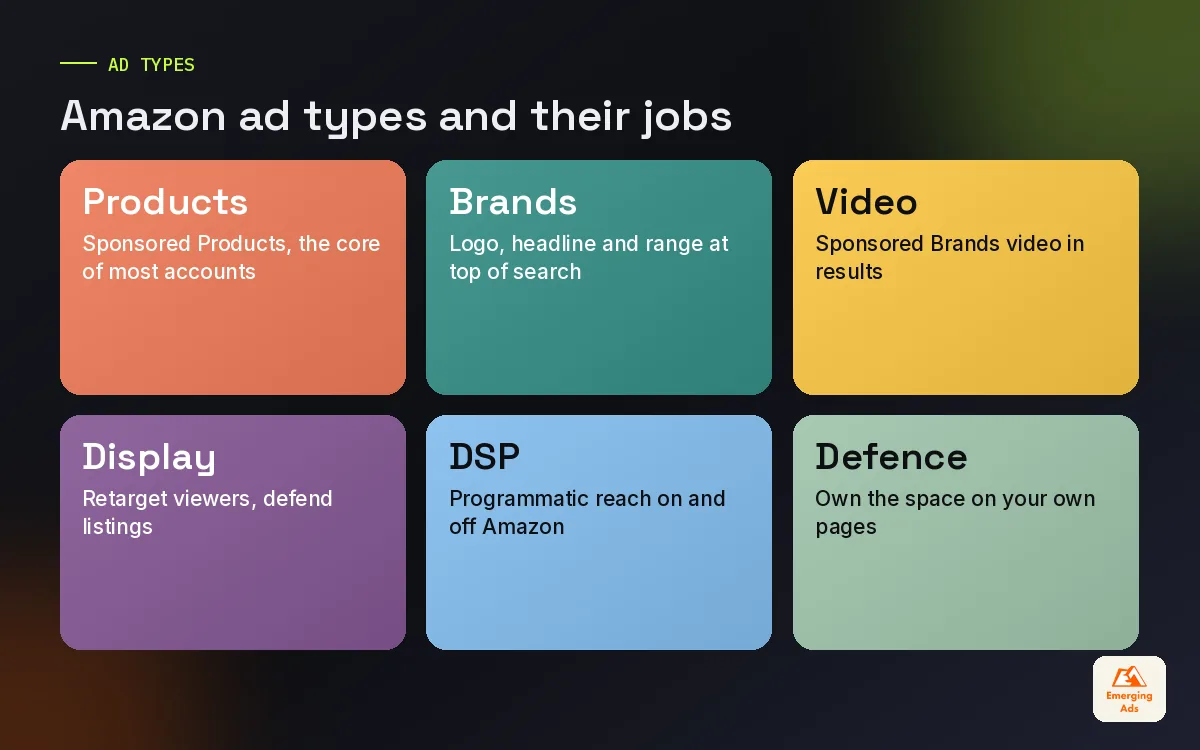
| Ad type | Where it shows | Best used for |
|---|---|---|
| Sponsored Products | In search results and on product pages, looks like a normal listing | Driving sales of individual products on specific search terms; the core of most accounts |
| Sponsored Brands | Top of search with your logo, headline and several products, or as video | Brand discovery, pushing a range, and defending your brand name |
| Sponsored Display | On and off Amazon, targeting product pages and shopper audiences | Retargeting product viewers and defending your own listings |
For larger brands, Amazon DSP adds programmatic display and video that can reach shoppers on and off Amazon using Amazon’s shopping data. It has higher entry points and needs more hands-on management. Our Amazon DSP advertising team usually brings it in after search campaigns are profitable and stable.
Sponsored Brands video deserves a special mention. Short product videos in search results often earn higher click-through rates than static placements, and they do not need a big production budget. A clear 15 to 30-second demo works well, and our video content production team often shoots these alongside social content so one shoot covers both.
03A campaign structure that stays manageable
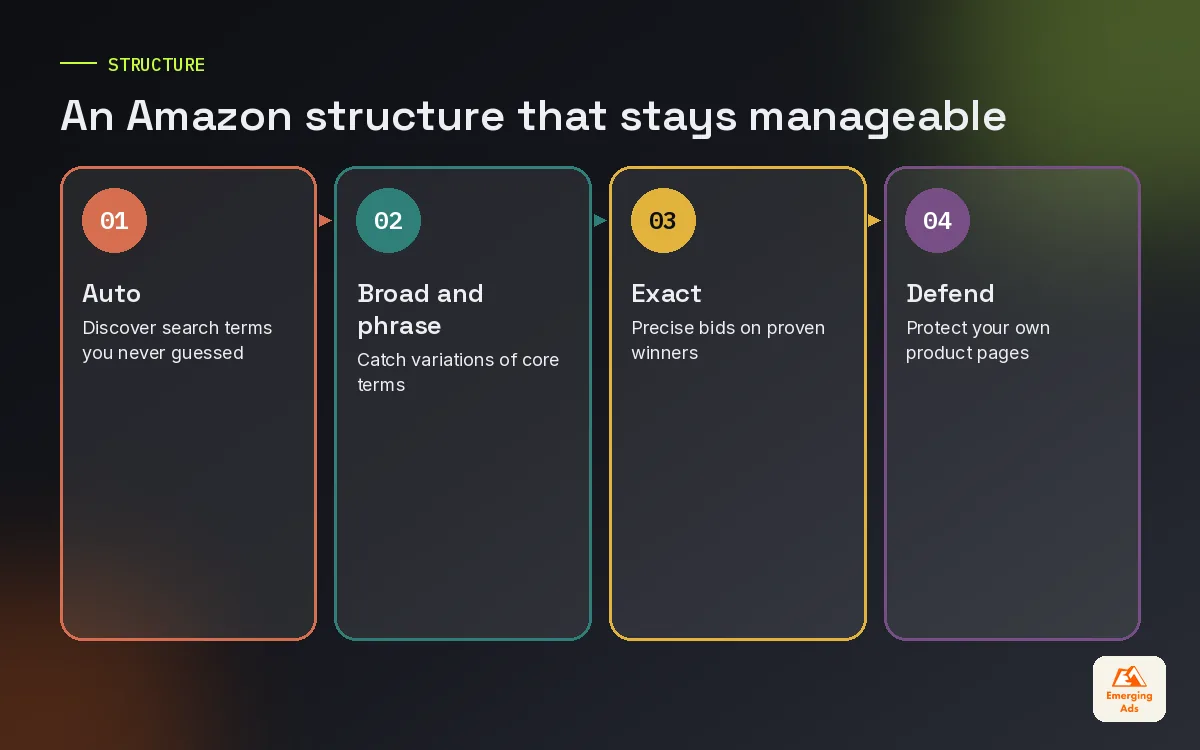
We inherit a lot of Amazon accounts with hundreds of campaigns and no clear logic. Structure matters because it decides how easily you can see what is working and control bids. Here is the setup we use for most sellers.
Discovery layer: automatic campaigns
Auto campaigns let Amazon match your product to searches and product pages based on your listing. They are excellent for finding search terms you would never have guessed. Run one per product or product group with modest bids.
Research layer: broad and phrase match
Manual campaigns on broad and phrase match catch variations of your core terms. They sit between discovery and control.
Control layer: exact match
Proven search terms move into exact-match campaigns where you set precise bids. This is where most profitable spend should end up over time.
Product targeting and brand defence
Separate campaigns target competitor product pages and your own listings, so you can bid differently on each. Defending your own product pages with Sponsored Display or Sponsored Products stops competitors taking the space below your buy box.
The key habit is harvesting: every week, move search terms that converted in auto and broad campaigns into exact match, and add them as negative exact in the campaigns they came from so the same search does not compete against itself. Our Amazon PPC management team runs this every week for every client.
04Keywords, bids and placements
Keyword research on Amazon starts with your listing and your competitors’ listings, then grows from real search term data. Tools help, but your own search term report after two weeks of auto campaigns is often the best keyword list you will ever get.
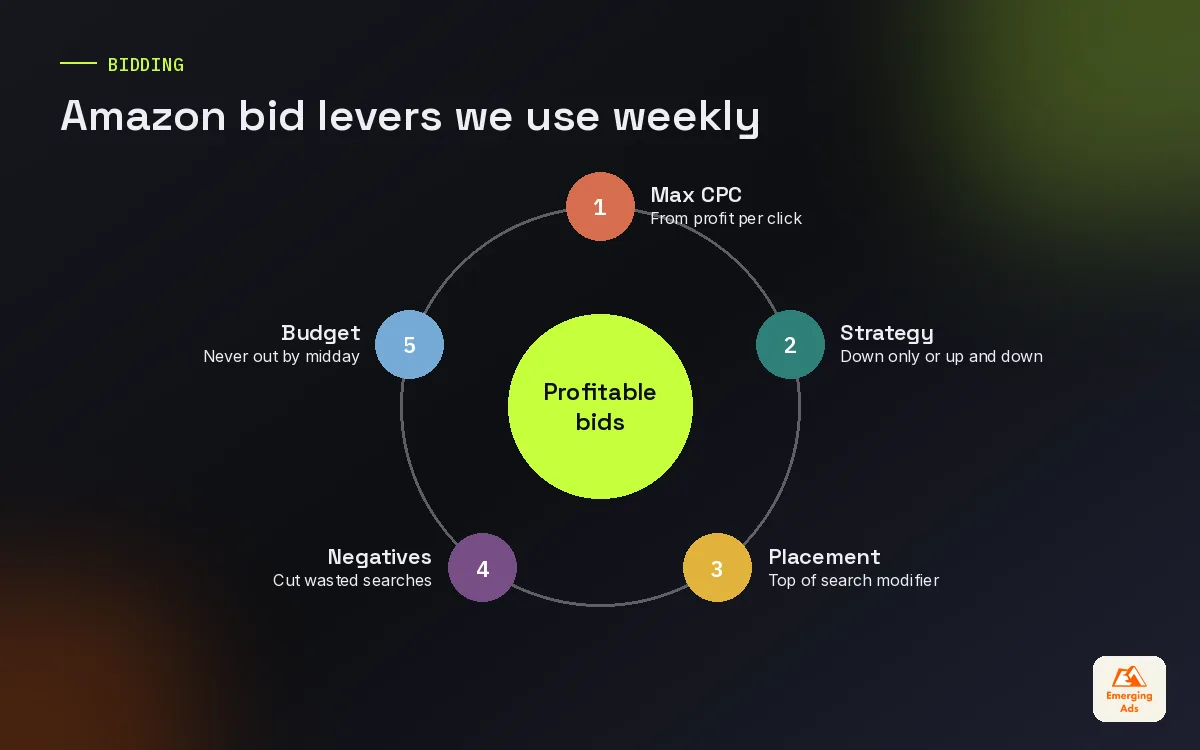
- Bid by value, not by suggestion. Amazon’s suggested bids reflect competition, not your margin. Work out the maximum cost per click you can afford from your conversion rate and profit per unit.
- Use bidding strategy deliberately. Dynamic down only is safer for new campaigns. Up and down can work well on proven exact-match terms.
- Adjust by placement. Top of search often converts better. Check the placement report and add placement adjustments where the numbers support it.
- Add negatives every week. Irrelevant searches that spend without selling should be added as negative phrase or negative exact.
05ACoS, TACoS and profit after fees
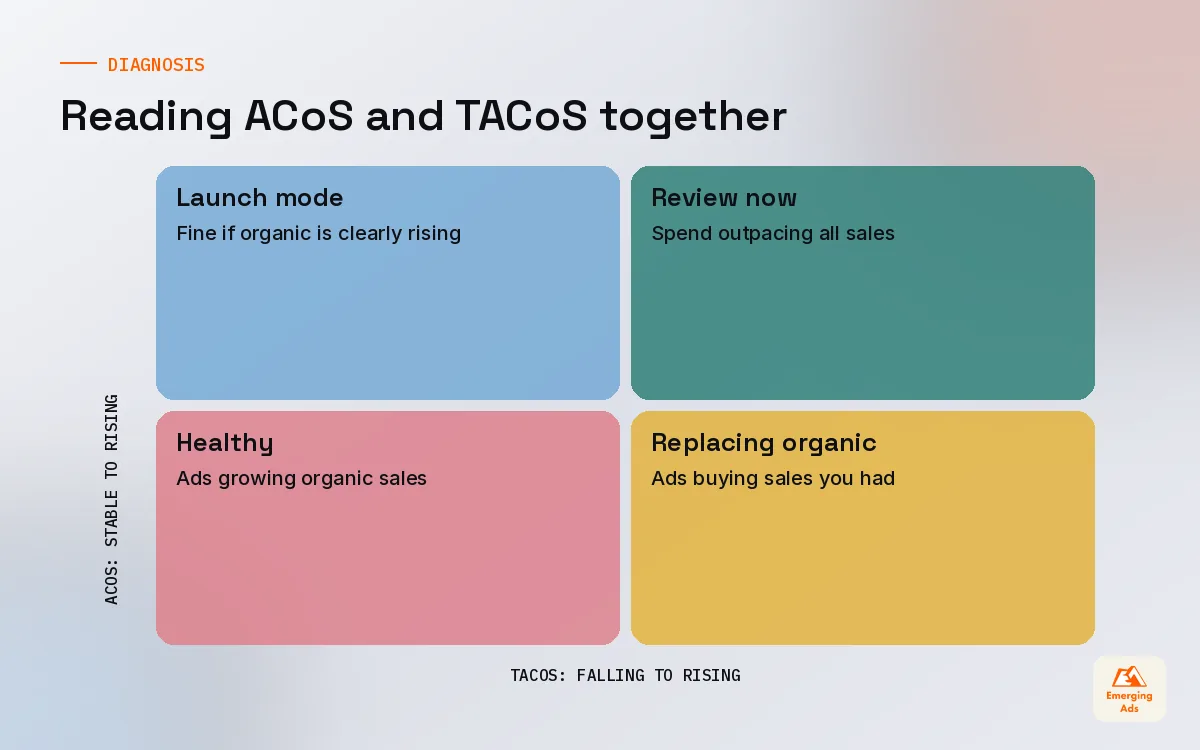
ACoS, advertising cost of sale, is ad spend divided by ad-attributed sales. It is the number Amazon puts front and centre. TACoS, total advertising cost of sale, is ad spend divided by total sales including organic. Watching both tells you far more than either alone.
| What you see | What it usually means |
|---|---|
| ACoS stable, TACoS falling | Ads are helping organic sales grow. Healthy. |
| ACoS stable, TACoS rising | Ad sales are replacing organic sales rather than adding to them. |
| ACoS rising, TACoS falling | Often fine during a launch while rank builds, if organic sales are clearly growing. |
| Both rising | Spend is growing faster than sales. Time to review structure and listings. |
Neither number includes Amazon’s referral and fulfilment fees, which is why we always go one step further and calculate profit after fees and ads. A campaign at a 25 percent ACoS can be very profitable for a product with a high margin and loss-making for one with a thin margin. Our main site has a deeper piece on ACoS vs TACoS if you want the full comparison, and our companion post on ad spend ROI covers the profit maths across every channel.
We report all three side by side in a Looker Studio dashboard for marketplace clients, so nobody has to export spreadsheets from Seller Central every Monday.
06Your listing is part of your ad
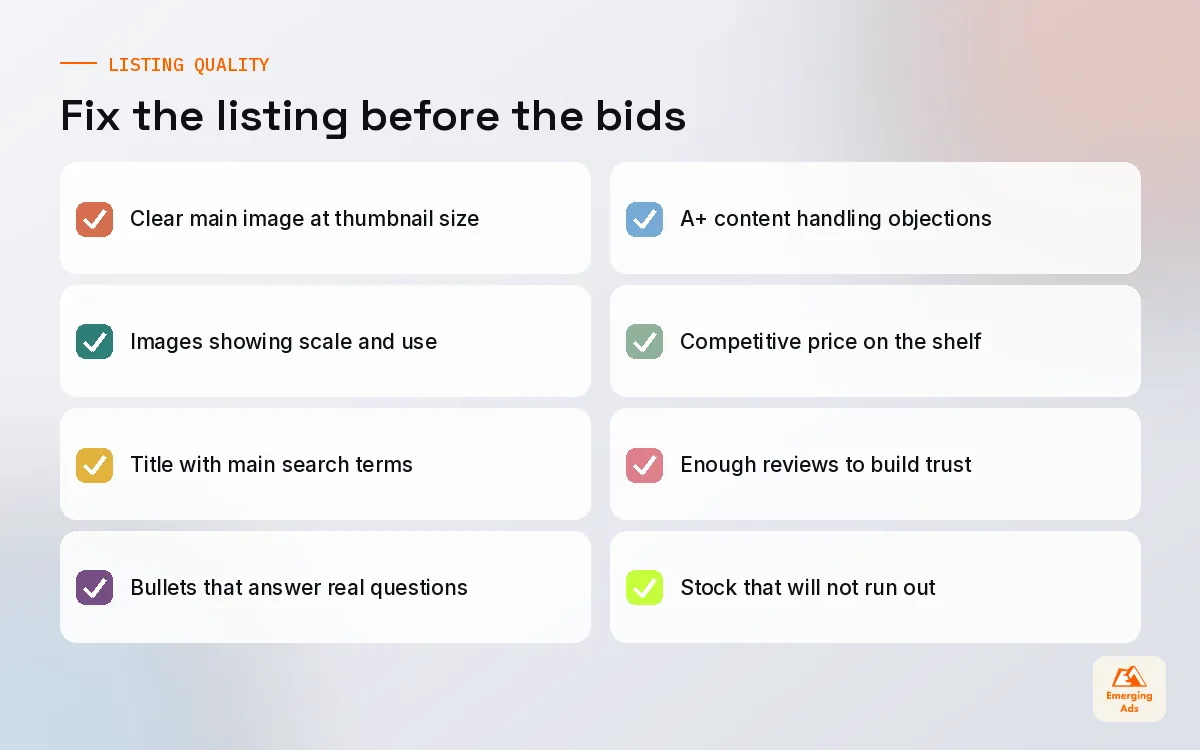
The most reliable way to lower Amazon ad costs is to improve the page people land on. Higher conversion rates mean Amazon shows your ads more readily and each click is worth more to you. Before raising bids, we check:
- Main image clear on a white background and readable at thumbnail size.
- Secondary images showing scale, use, benefits and comparisons.
- Title containing the main search terms without keyword stuffing.
- Bullets that answer the questions buyers ask in reviews and Q&A.
- A+ content that tells the brand story and handles objections.
- Price competitive with the products shown next to yours.
- Enough reviews and a rating that does not scare people off.
Our Amazon listing optimisation service is often the first thing we recommend to sellers who want to grow ad spend, because it makes every future click cheaper.
07Launching a new product with PPC
New products have no sales history, few reviews and no organic rank, so ads carry most of the load at first. A launch plan we have used many times:
- Weeks 1 to 2: auto campaigns plus exact match on the most relevant terms, bids set to win visibility, and Sponsored Display on your own related products.
- Weeks 3 to 6: harvest converting terms, cut non-converting ones, add Sponsored Brands once there are enough products or a video.
- Weeks 7 onwards: shift focus from rank to profit, lower bids where organic rank has improved, and track TACoS closely.
Launches go faster when the listing, pricing and stock are right from day one. Running out of stock mid-launch undoes weeks of ranking work. We plan these together in our Amazon launch strategy work.
08A weekly Amazon PPC routine
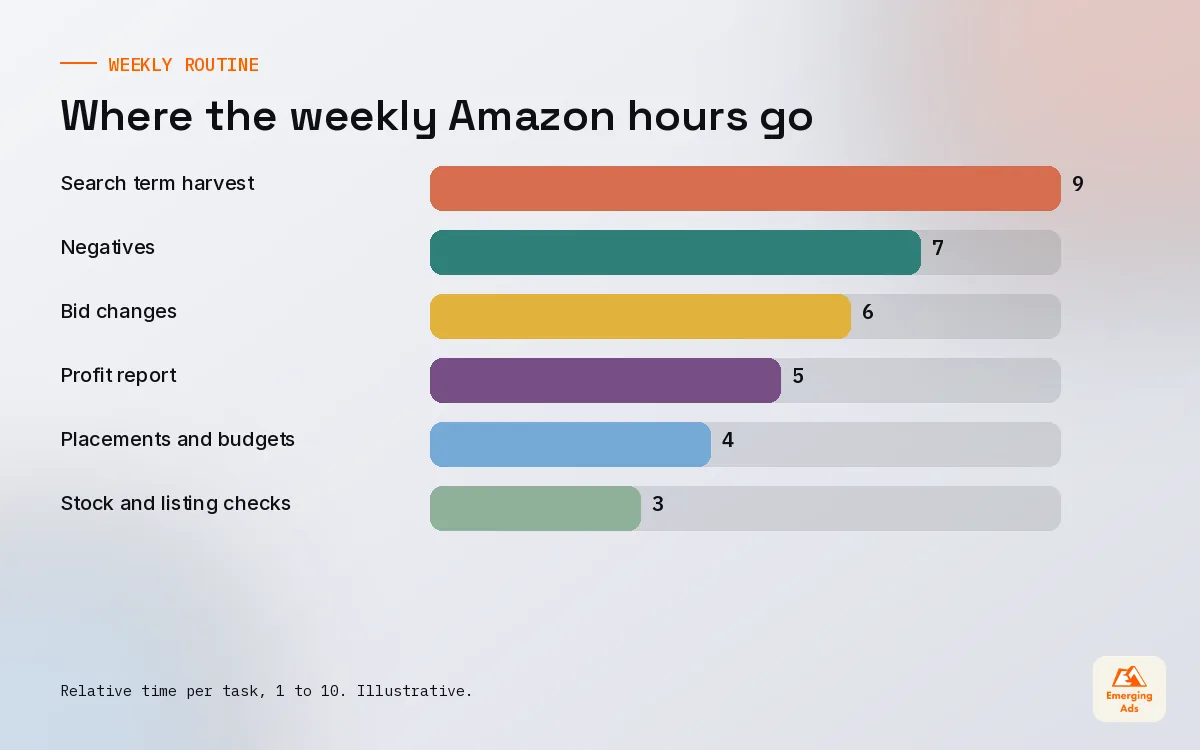
Amazon accounts reward steady, boring maintenance more than bursts of big changes. This is the routine our team runs every week.
- Download the search term report and harvest winners into exact match.
- Add negatives for terms that spent without converting over a meaningful number of clicks.
- Adjust bids on keywords above or below their target profit.
- Check placement performance and adjust top-of-search modifiers.
- Review budget caps so the best campaigns do not run out by midday.
- Check stock levels, price changes and any listing suppressions.
- Update the profit report and flag any product whose TACoS is climbing.
It is not glamorous, but it is how accounts improve month after month. Sellers on Seller Central and vendors on Vendor Central follow the same logic, with different reporting, and brands selling on their own site as well should read Amazon results next to their wider e-commerce marketing numbers so the two channels are not fighting over the same buyers. If you would rather hand it over, our Seller Central management and full Amazon advertising service handle it end to end, and the oldemergingads.com homepage shows how Amazon fits into our wider paid media work.
Frequently asked questions
Straight answers to what clients ask us most about amazon ppc.
What is Amazon PPC?
How much should I spend on Amazon PPC?
What is a good ACoS on Amazon?
What is the difference between ACoS and TACoS?
Should I use automatic or manual campaigns?
How often should I adjust Amazon PPC bids?
Why are my Amazon ads getting clicks but no sales?
Do Amazon ads help organic ranking?
What are negative keywords on Amazon?
Is Amazon DSP worth it?
Can I run Amazon PPC myself?
Is your Amazon ad spend growing faster than your sales?
Give us read access to your advertising console. We will review structure, search terms and profit after fees, and send a clear list of what to cut and what to scale.
Book your free audit