Ad Creative Testing: The Practical Guide We Hand to New Clients
On most accounts we run, creative is the biggest lever left. Targeting has been handed to the algorithms, bids are mostly automated, and what you put in front of people decides the rest. This is how we test ads so that every week teaches us something we can use.
Key takeaways
- Test big ideas before small details. A new angle or hook moves results far more than a new button colour or background.
- Give each test a single question, a budget, a duration and a pass mark agreed before launch, so results cannot be argued into a win.
- Separate testing from scaling. A dedicated testing campaign keeps experiments from disturbing the campaigns that pay the bills.
- Judge ads on the metric closest to profit you can measure reliably, and use hook rate and click-through only to explain why.
- Plan for fatigue. Winning ads decline, so the testing pipeline must keep producing new candidates every week.
01Why creative testing matters more than ever
Five or six years ago, a skilled media buyer could win on audiences. You found an interest nobody else was using, stacked lookalikes cleverly, and costs dropped. Those days are mostly gone. Meta, TikTok and Google now do most of the targeting themselves, often with broad or automated audiences that perform as well as anything built by hand.
What the algorithms cannot do is make your ads for you. The creative has become the targeting: an ad about joint pain in older runners finds older runners with joint pain, whatever audience settings you choose. That shift means creative testing is no longer a side project for the design team. It is the main job of a paid media team.
On the accounts we manage, the difference between a flat month and a strong one usually comes down to whether we found one or two new winning ads. That is why every client plan we write has a ring-fenced creative testing budget, as described in our media planning guide.
The algorithm decides who sees your ad. Your ad decides whether they care.
02What to test first: the creative hierarchy
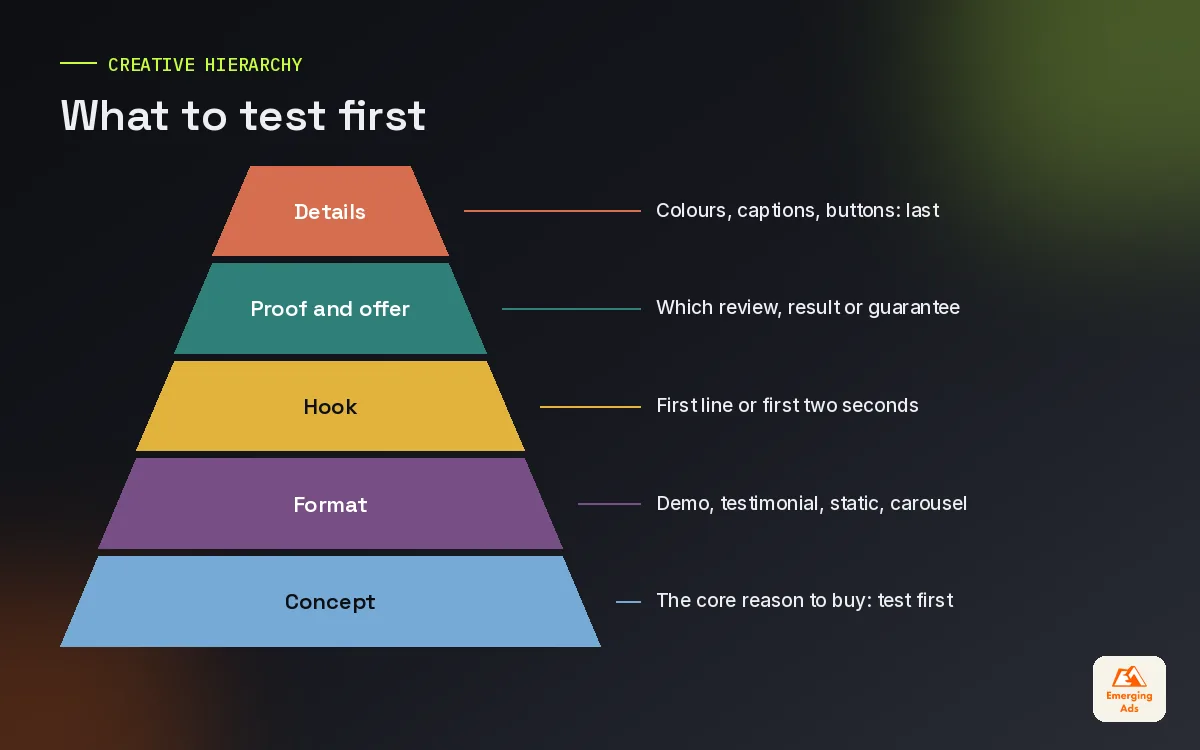
Not every test is worth running. Changing a background colour might move results by a sliver. Changing the core message can double or halve them. We test in this order, from the biggest levers down.
- Concept or angle. The core reason to buy. Saves time, saves money, fixes a problem, makes you look good, feels like a treat. Different angles reach different people.
- Format. Talking head, product demo, testimonial, static image, carousel, meme style, comparison. The same angle can live or die by format.
- Hook. The first line or first two seconds. Five hooks on the same body often produce very different results.
- Proof and offer. Which review, which result, which guarantee, which price framing.
- Details. Captions, colours, thumbnails, calls to action, music. Worth testing only once the big levers are settled.
Where new test ideas come from
The best ideas rarely come from a brainstorm. They come from customer reviews, sales call notes, support tickets, comments on your ads and the search terms people use to find you. When a customer writes “I finally stopped waking up with a sore back”, that sentence is a hook waiting to be filmed. We keep a running list of these phrases for every client and turn the strongest ones into briefs each week.
Most accounts we audit spend their testing effort at the bottom of this list, making small variations of one idea. That is safe, but it rarely finds a step change.
03Setting up a creative test properly
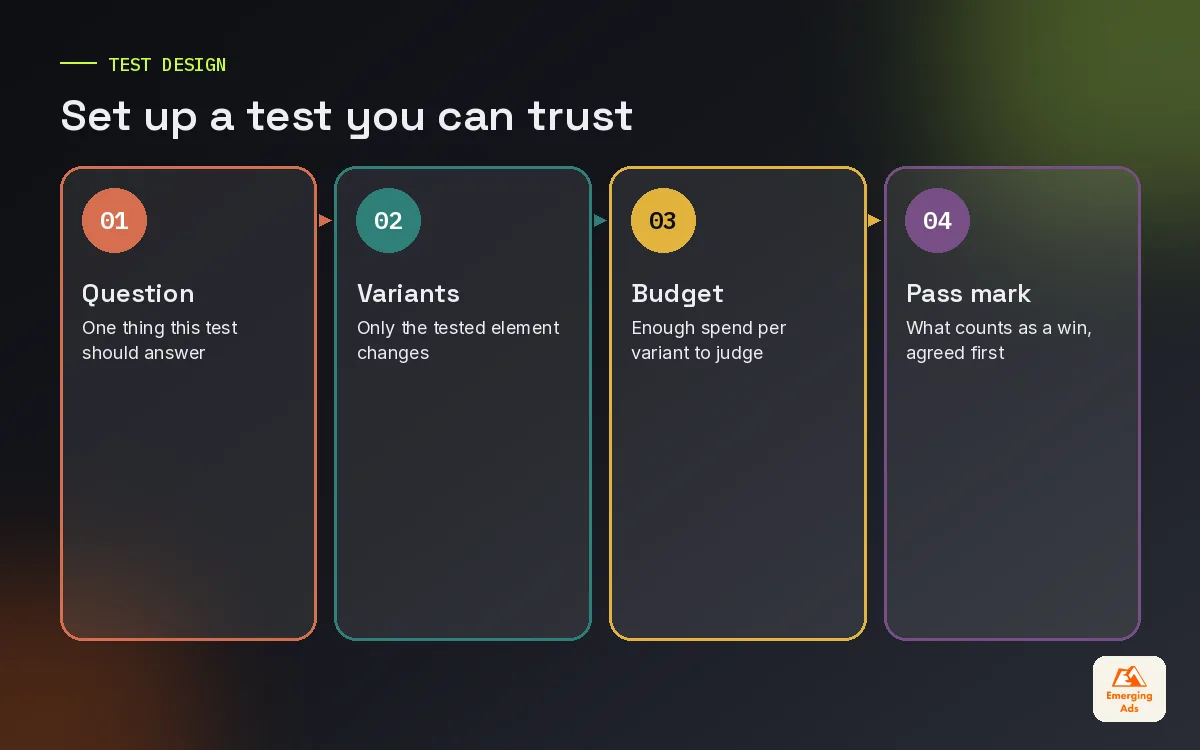
A test is only useful if you can trust the result. That means planning it before it runs. For every test, we write down four things.
| Element | What we write down | Example |
|---|---|---|
| Question | The single thing this test should answer | Does a pain-point angle beat a lifestyle angle for this product? |
| Variants | The ads that answer it, with only the tested element changing | Three pain-point ads and three lifestyle ads, same offer |
| Budget and duration | Enough spend to reach a meaningful number of conversions | Seven days, or until each variant reaches the agreed spend |
| Pass mark | The result that counts as a win | Cost per purchase at least 20 percent below the current best ad |
Campaign structures that work
On Meta, we usually run a dedicated testing campaign separate from the main scaling campaigns. Each concept gets its own ad set with a fixed budget, so the algorithm cannot starve new ideas by pushing all the money to one ad. Winners then move into the scaling campaign. Some accounts use Meta’s built-in A/B test tool for cleaner splits, which is worth it for bigger questions.
On TikTok, the structure is similar, with more ads per ad group because creative burns faster. See our TikTok ads guide for platform specifics. On YouTube, we test hooks by running separate edits of the same video in the same campaign and comparing view rates and conversion rates.
04How much budget a creative test needs
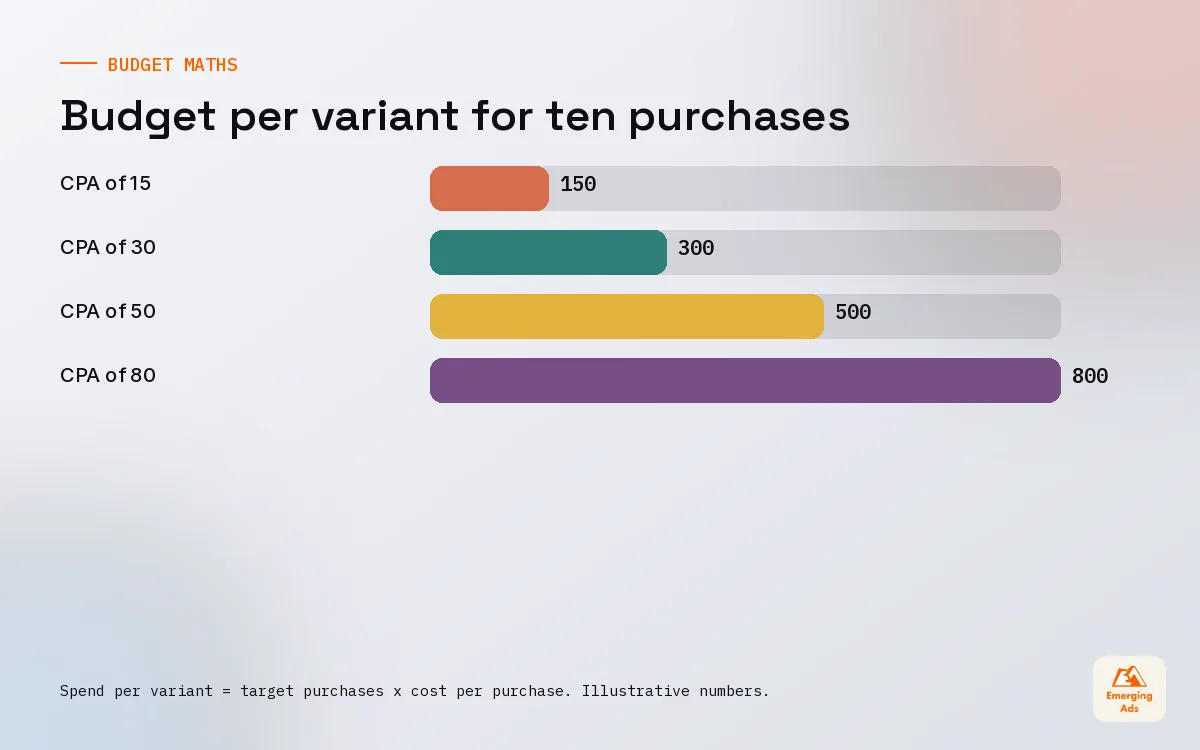
The honest answer is: enough for each variant to reach a meaningful number of the event you are judging it on. For purchase-optimised tests, a handful of conversions per variant is too few to trust. Many teams judge winners on three or four sales and then wonder why the winner fails at scale.
A practical approach when conversion volume is low:
- Judge early on a leading metric, such as cost per add to cart or cost per landing page view, to cut obvious losers quickly.
- Keep the promising ones running until they reach a sensible number of purchases before declaring a winner.
- Accept that small accounts can test fewer ideas at once, and prioritise bigger swings.
05Reading the results without fooling yourself
Ad platforms show dozens of metrics. For creative decisions, we group them into two buckets.
| Metric | What it tells you | How we use it |
|---|---|---|
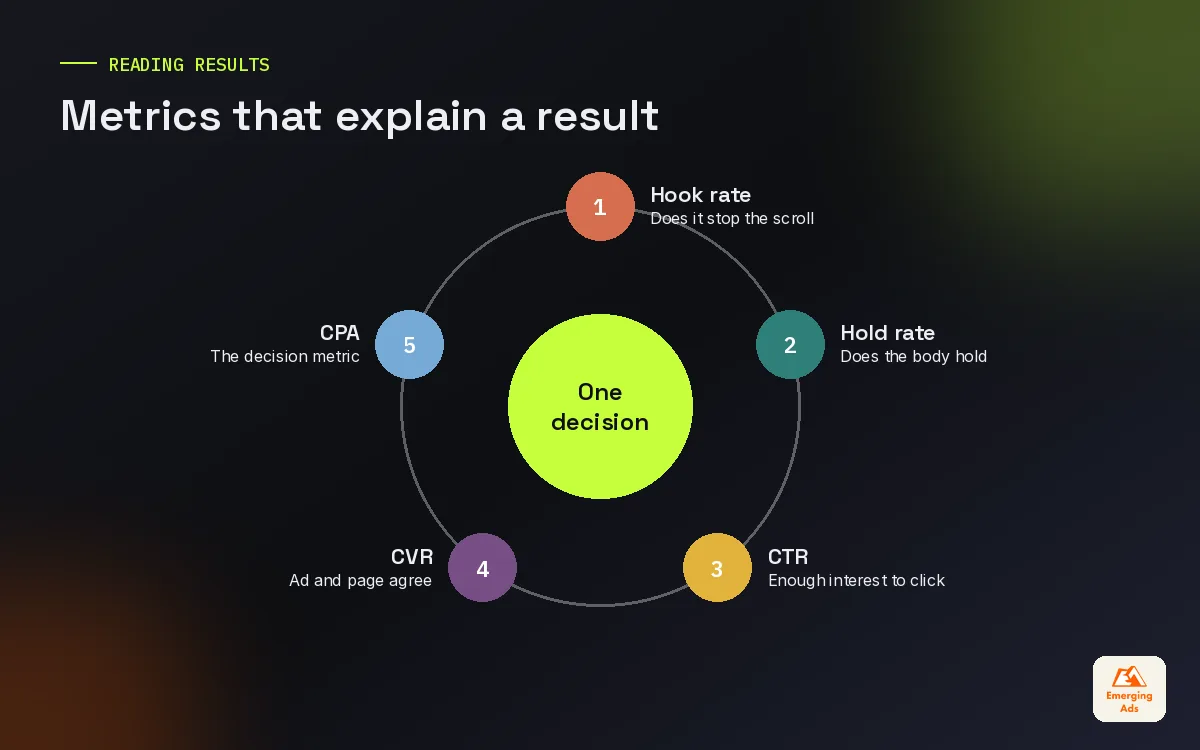
| Hook rate (3-second views over impressions) | Whether the opening stops the scroll | Diagnose weak hooks |
| Hold rate (longer views over 3-second views) | Whether the body keeps attention | Diagnose weak middles |
| Click-through rate | Whether the ad creates enough interest to click | Diagnose weak calls to action or offers |
| Cost per purchase or qualified lead | Whether the ad makes money | The decision metric |
| Conversion rate after the click | Whether the ad and page agree | Diagnose mismatch with the landing page |
The decision metric should always be the one closest to profit you can measure reliably. The others explain why an ad won or lost, which is what feeds the next round of ideas. An ad with a brilliant hook rate and a poor purchase rate has a hook that attracts the wrong people or a promise the landing page does not keep. A tidy landing page design that matches the ad often fixes the second problem.
Watch for false winners too. An ad that wins by getting cheap clicks from people who never buy will look great on click-through rate and poor on everything that matters.
06Scaling winners without breaking them
Finding a winner is half the job. Moving it into the main campaign and increasing spend without losing its performance is the other half.
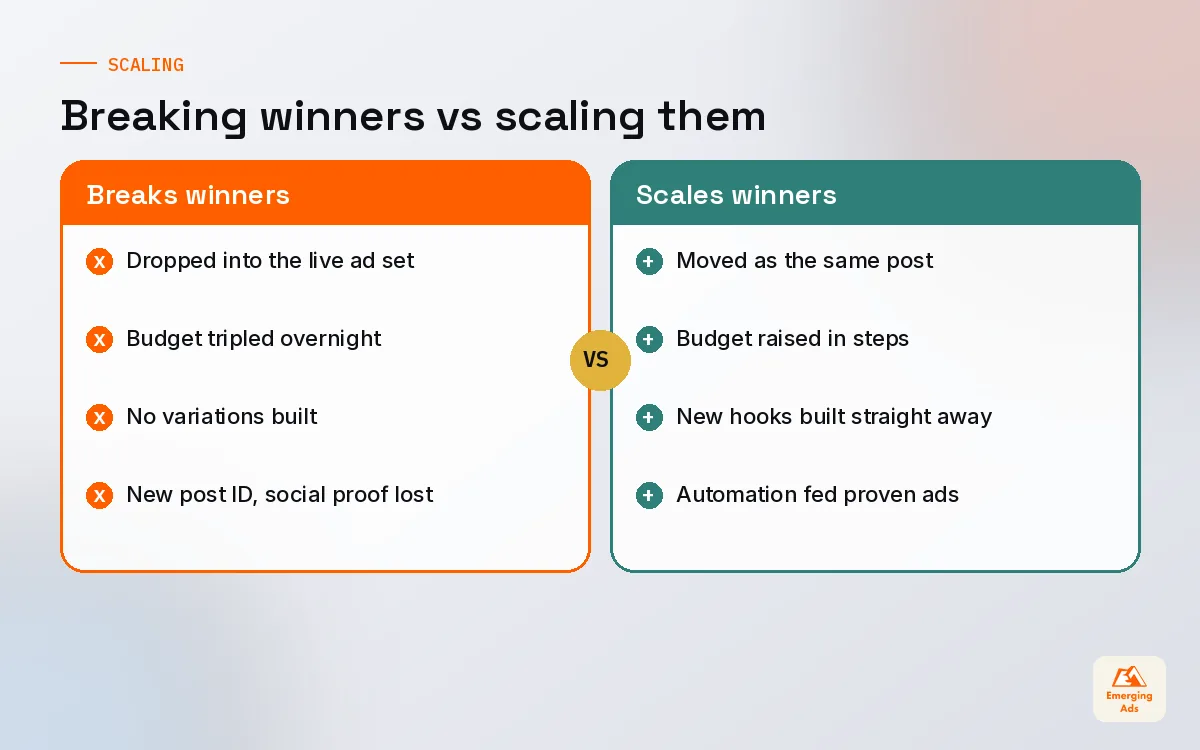
- Move the winning ad, not the whole ad set. Duplicate the ad into your scaling campaign, keeping the same post ID on Meta so the social proof carries over.
- Increase budgets gradually. Big overnight jumps often reset learning. We usually raise budgets in steady steps every few days while watching cost per result.
- Build variations straight away. A winning angle deserves new hooks, new formats and new faces before the original fatigues.
- Let automation help once you have winners. Campaign types like Meta Advantage+ campaigns work best when fed a steady supply of proven creative.
The same principle applies on TikTok, where boosting a winning organic post as a Spark Ad often keeps performance stronger than re-uploading it as a new ad.
07Spotting and managing creative fatigue
Every winning ad eventually gets tired. The audience has seen it too many times, the novelty wears off, and costs climb. Fatigue usually shows up in this order:
- Frequency rises within the same audience.
- Hook rate and click-through rate drift downward.
- Cost per result creeps up over one to three weeks.
- Comments turn from questions to complaints about seeing the ad again.
The fix is not to panic and turn everything off. Refresh the hook, change the first frame, swap the person on screen or rework the format while keeping the winning angle. Many of our longest-running winners are on their fifth or sixth version of the same idea.
To keep ahead of fatigue, production has to run on a schedule. Our video content production team films in batches designed for testing, and our Canva design services handle fast static and carousel variations between shoots.
08A weekly creative testing rhythm
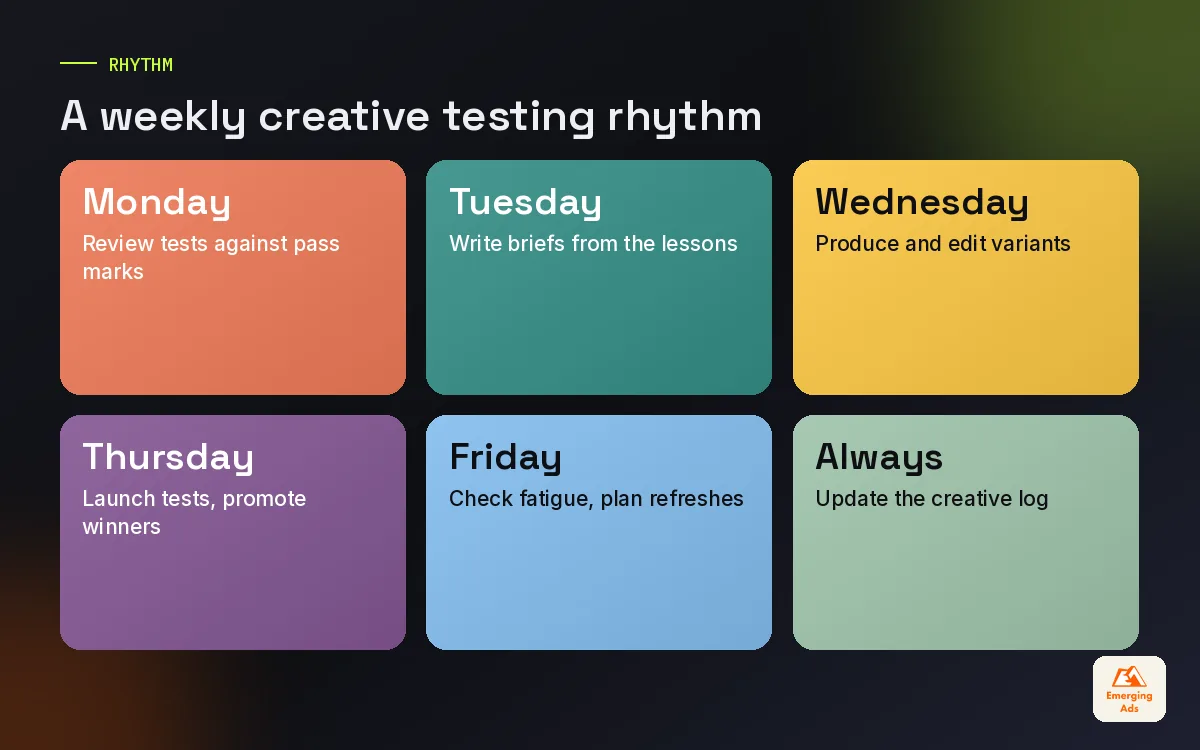
Here is the weekly rhythm we run on accounts spending enough to test every week. Smaller accounts can run the same cycle every two weeks.
| Day | Task |
|---|---|
| Monday | Review last week’s tests against their pass marks and note what we learned |
| Tuesday | Write briefs for the next round based on those lessons |
| Wednesday | Produce or edit new variants |
| Thursday | Launch tests in the testing campaign; move winners into scaling |
| Friday | Check fatigue signals on live winners and plan refreshes |
Keep a simple creative log of every test, the question, the result and the lesson. After a few months, that log becomes the most valuable document in the account, because it shows which angles, formats and hooks work for your buyers. When we run a Facebook ads audit on a new client, a missing creative log is one of the first gaps we flag. If you want a team to run this rhythm for you across Meta ads, TikTok and YouTube, see how we work on the oldemergingads.com homepage.
Frequently asked questions
Straight answers to what clients ask us most about ad creative testing.
What is ad creative testing?
How many creatives should I test at once?
How long should a creative test run?
What should I test first in my ads?
What is a good hook rate?
Should I test creatives in a separate campaign?
What is creative fatigue?
How often should I refresh ad creative?
Is dynamic creative a good way to test?
How do I know if a winning ad is a real winner?
Can I test creatives with a small budget?
Not sure which of your ads are actually working?
Share access to your ad account. We will review your last 90 days of creative, find the patterns behind your winners, and give you a testing plan for the next month.
Book your free audit