Ad Spend ROI: The Practical Guide We Hand to New Clients
ROAS tells you how much revenue came back. ROI tells you whether you actually made money. We have taken over plenty of accounts with a healthy ROAS and a shrinking bank balance, and this guide explains why that happens and how to fix it.

Key takeaways
- Ad spend ROI measures profit returned per unit of ad spend, after product costs, fees and the ad spend itself. ROAS only measures revenue returned.
- A 3x ROAS can be a loss if your gross margin is 30 percent. Always work out your break-even ROAS before setting targets.
- Use blended numbers from your store or CRM as the source of truth, and treat each ad platform’s reported return as directional.
- The biggest ROI gains we see rarely come from bidding tricks. They come from better margins, higher order values and fixing leaky landing pages.
- Judge new customer campaigns on a longer window than retargeting, because first orders are often the least profitable part of a customer’s life.
01What ad spend ROI means and why ROAS is not enough
Return on investment is the oldest question in advertising: did the money we spent come back with more attached? Ad spend ROI applies that question to your paid media, and the honest version includes every cost that sits between a click and a profit.
The formula we use with clients is simple: ad spend ROI = (gross profit from ad-driven sales minus ad spend) divided by ad spend. Gross profit here means revenue minus product cost, shipping, payment fees, marketplace fees and any discounts you gave away to win the sale.
ROAS, return on ad spend, is revenue divided by ad spend. It is useful for day-to-day optimisation inside platforms because it is quick to calculate and every platform reports it. The trouble is that revenue is not profit. A campaign selling low-margin products at a 4x ROAS can make less money than a campaign selling high-margin products at 2.5x.
ROI vs ROAS at a glance
| ROAS | Ad spend ROI | |
|---|---|---|
| Formula | Revenue divided by ad spend | (Gross profit minus ad spend) divided by ad spend |
| What it tells you | How much revenue each unit of spend returned | Whether the ads made money after costs |
| Where it lives | Every ad platform dashboard | Your own reporting, built from store and finance data |
| Best used for | Comparing campaigns inside one channel | Deciding budgets and whether to scale |
02How to calculate ad spend ROI step by step
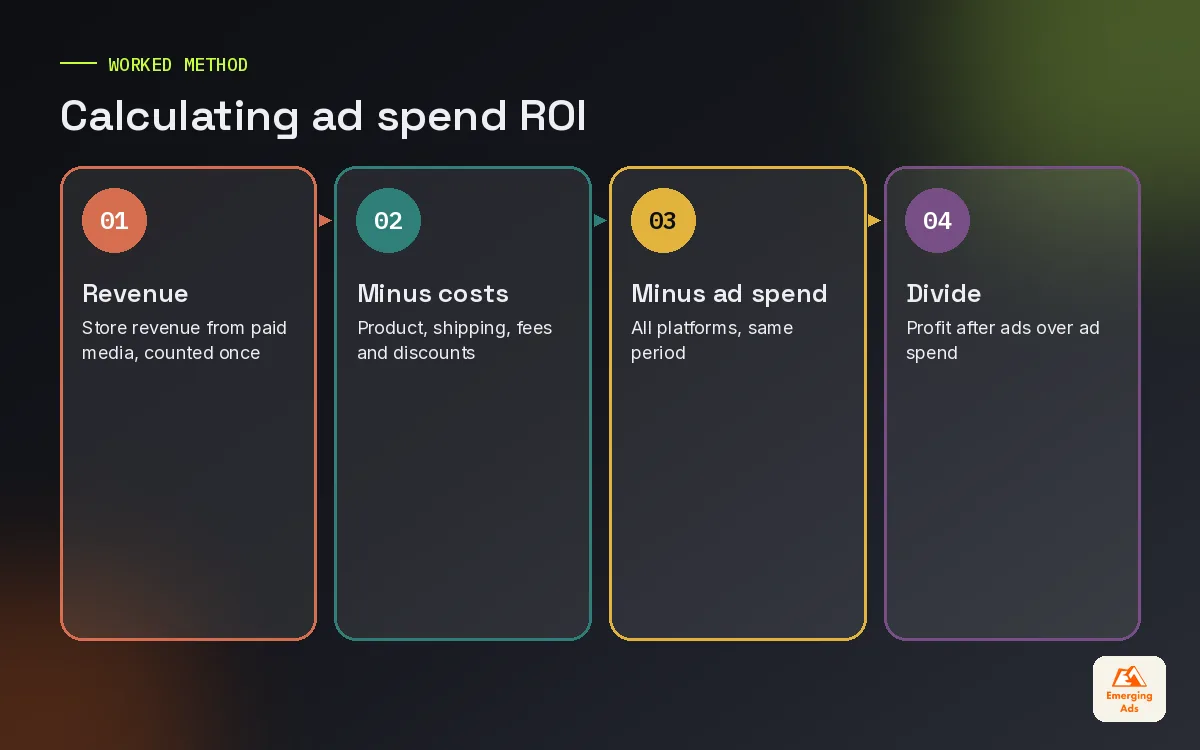
Here is a worked example with illustrative numbers. The point is the method, not the figures.
- Take revenue from paid media. Say your ads drove 50,000 in revenue last month.
- Subtract cost of goods. If products cost you 40 percent of the selling price, that is 20,000.
- Subtract variable costs. Shipping, packaging, payment and platform fees might add another 8,000.
- You now have gross profit before ads: 22,000.
- Subtract ad spend. If you spent 15,000, profit after ads is 7,000.
- Divide by ad spend. 7,000 divided by 15,000 is roughly 0.47, or a 47 percent ad spend ROI.
The same account would report a ROAS of about 3.3x. Both numbers are true. Only one tells you how much money you made.
03Break-even ROAS: the number every account needs
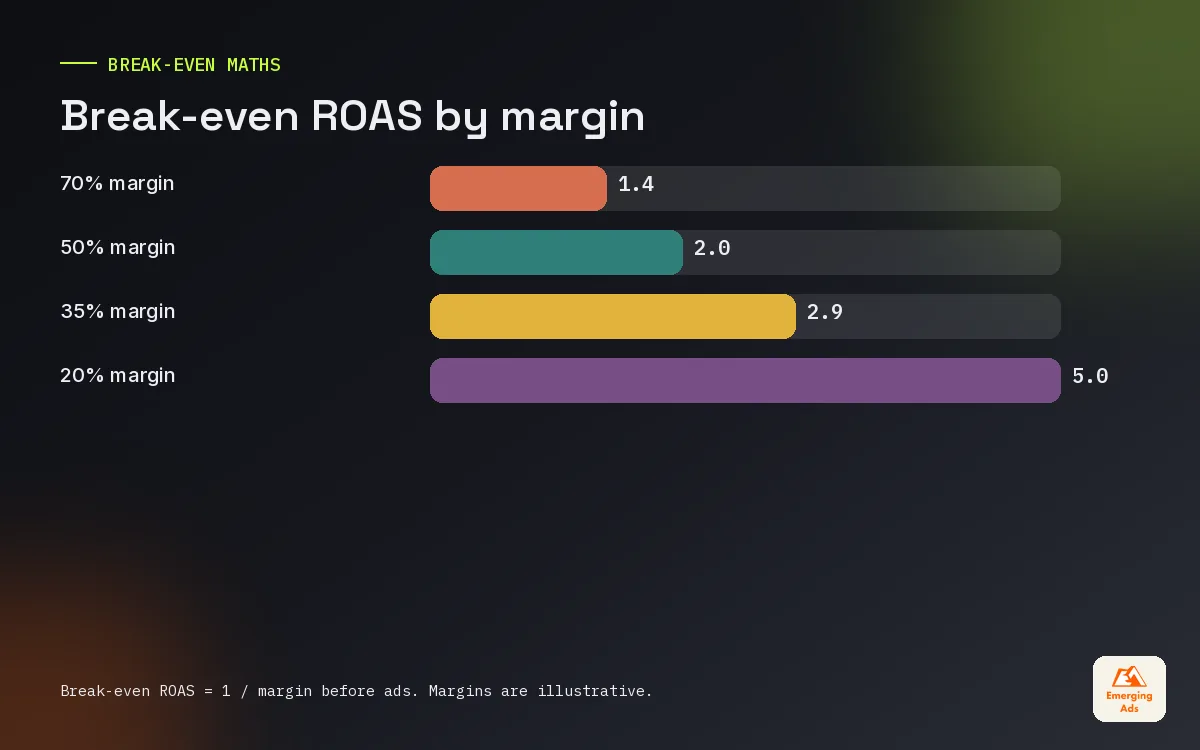
Before setting any ROAS target, work out the ROAS at which you neither make nor lose money. The formula is break-even ROAS = 1 divided by your contribution margin before ads, where contribution margin is the share of revenue left after product and variable costs.
| Margin before ads | Break-even ROAS | What it means in practice |
|---|---|---|
| 70 percent (software, digital products) | About 1.4x | You can scale aggressively on modest ROAS |
| 50 percent (many DTC brands) | 2.0x | A 3x ROAS leaves a healthy profit |
| 35 percent (competitive retail) | About 2.9x | A 3x ROAS is barely profitable |
| 20 percent (low-margin resale) | 5.0x | Paid media is hard to make work without repeat purchases |
These are illustrative margin bands, not benchmarks for any category. Your own numbers will differ, which is exactly why you need to calculate them. We go deeper on margin maths in our companion guide to contribution margin, which follows later this week.
Once you know break-even, targets become obvious. A brand at 50 percent margin that wants a 30 percent return on ad spend needs roughly a 2.6x ROAS across paid media. The buyer can then run campaigns against a number that is tied to profit instead of a number someone picked because it sounded good.
04Why platform-reported ROI is almost always too high
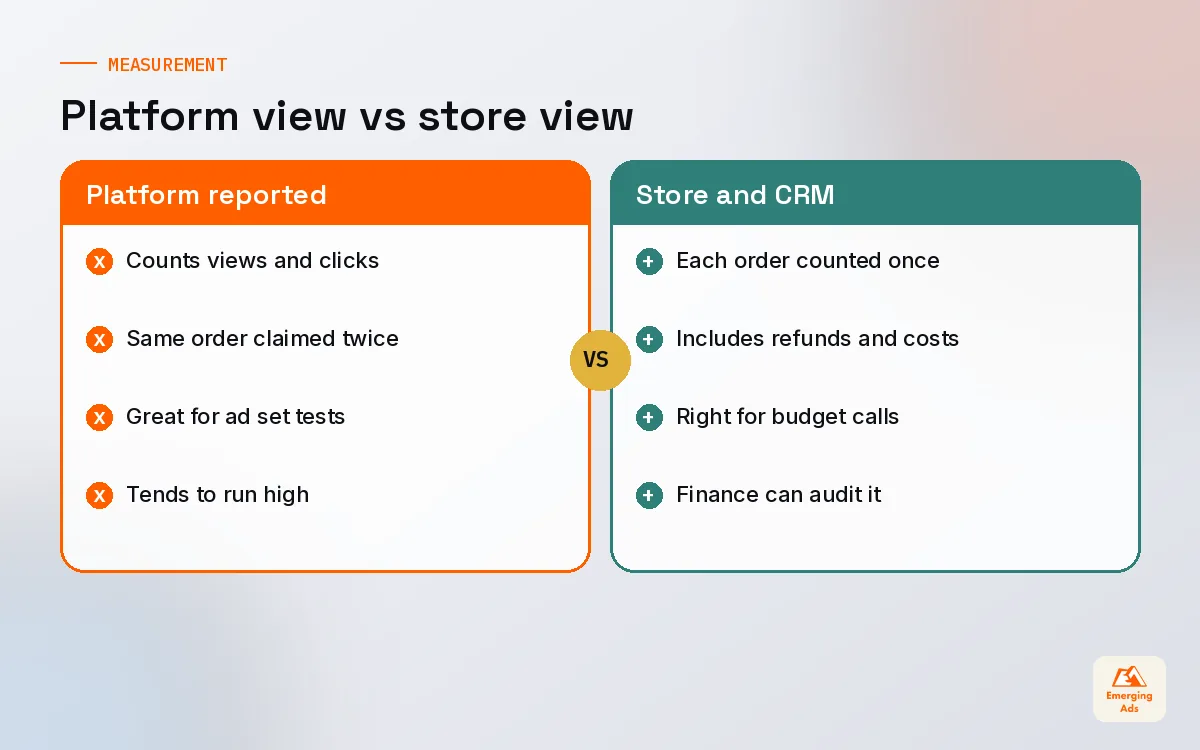
Every ad platform wants to prove it is working, and the way they count conversions reflects that. Meta counts conversions within its attribution window after a view or click. Google counts conversions where its ads played a part. When a buyer clicks a Google ad after seeing an Instagram ad, both platforms may count the same sale.
On accounts we inherit, the sum of platform-reported revenue regularly exceeds the actual revenue in the store for the same period. That gap does not mean the platforms are lying. They are each telling the story from their own seat.
- Use a blended view as the top line. Total revenue divided by total ad spend, often called MER (marketing efficiency ratio), measured from your store.
- Use platform numbers to optimise inside the platform. They are good at telling you which ad set beats another, even if the absolute number is inflated.
- Run holdout tests on your biggest channels. Pausing a channel in one region or for one week shows how much revenue truly depends on it.
For brands with longer sales cycles or many touchpoints, proper attribution modelling or a dedicated tool like Hyros tracking can close much of the gap. For smaller accounts, a weekly blended report is usually enough.
05What actually improves ad spend ROI
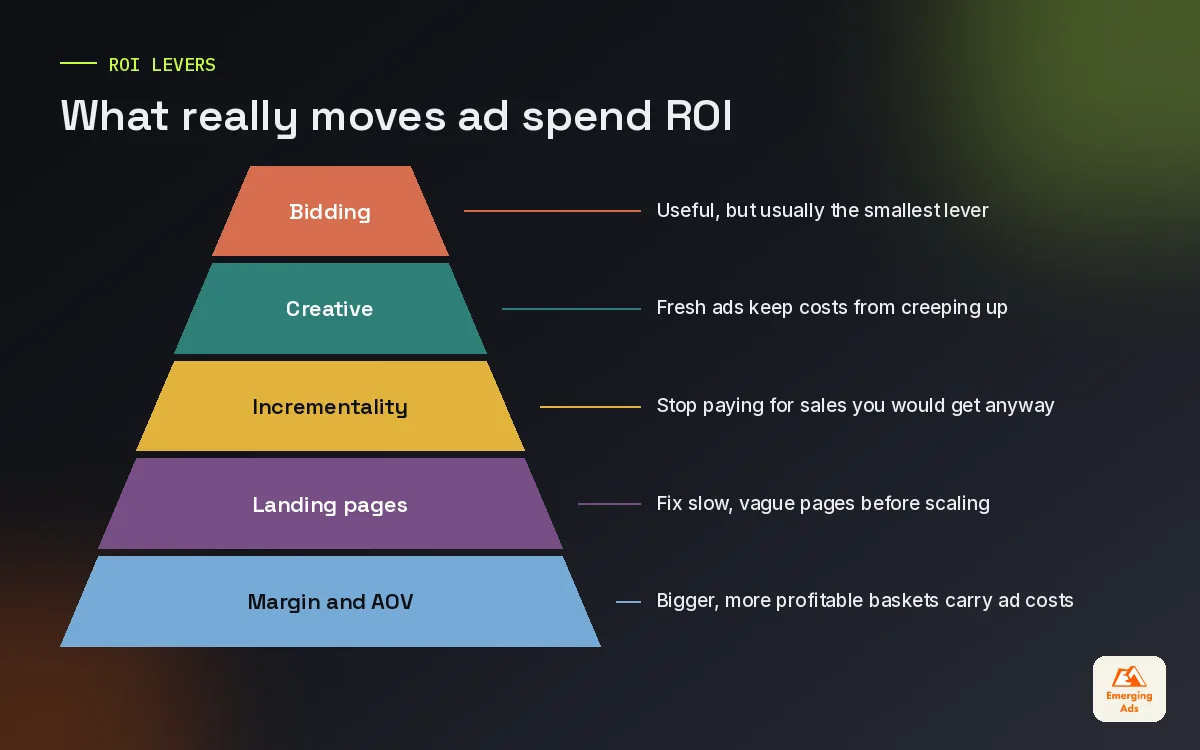
When clients ask us to improve ROI, they usually expect bidding changes. Bidding matters, but in our experience the larger gains sit elsewhere in the funnel. Here is roughly the order we work through.
Raise the value of each order
Bundles, thresholds for free shipping and sensible post-purchase offers lift average order value without extra ad spend. Every unit of ad cost is spread across a bigger basket.
Fix the landing experience
If paid traffic lands on a slow page with a vague headline, you pay for clicks that never had a chance. Our conversion rate optimisation work regularly does more for ROI than any change inside the ad account.
Stop paying for sales you would get anyway
Branded search and aggressive retargeting often show the best ROAS in the account and the weakest incremental return. Trim them carefully and watch what happens to total revenue.
Cut products that cannot carry ad costs
Some products simply do not have the margin to be advertised. Excluding them from shopping feeds and Performance Max campaigns can lift ROI overnight.
Refresh creative on a schedule
Fatigued ads raise costs slowly enough that nobody notices until the month is gone. Regular new creative keeps Meta advertising costs in check far better than bid tweaks do.
06ROI by channel: how to compare fairly
Comparing channels on ROI is where many reports mislead. A remarketing campaign will always look better than a prospecting campaign, because it talks to people who were already close to buying. That does not mean you should move all your budget into remarketing, because the remarketing pool would dry up within weeks.
| Channel type | Typical ROI pattern | Fair way to judge it |
|---|---|---|
| Prospecting on social | Lower first-order ROI, feeds everything else | New customer cost and 60 to 90 day value |
| Search (non-brand) | Solid, steady ROI on intent | Cost per new customer and margin by keyword theme |
| Branded search | Very high reported ROI | Incremental lift from holdout tests |
| Remarketing | High reported ROI, limited scale | Incremental lift and frequency caps |
| Marketplace ads | Depends heavily on fees and margin | Profit after marketplace fees and TACoS |
For marketplace sellers the maths has an extra layer. Amazon referral and fulfilment fees can eat a large slice of revenue, so a campaign that looks strong on ACoS can still lose money. Our Amazon PPC management reporting always shows profit after fees, not just ad cost against sales.
07Building an ROI report your finance team will trust
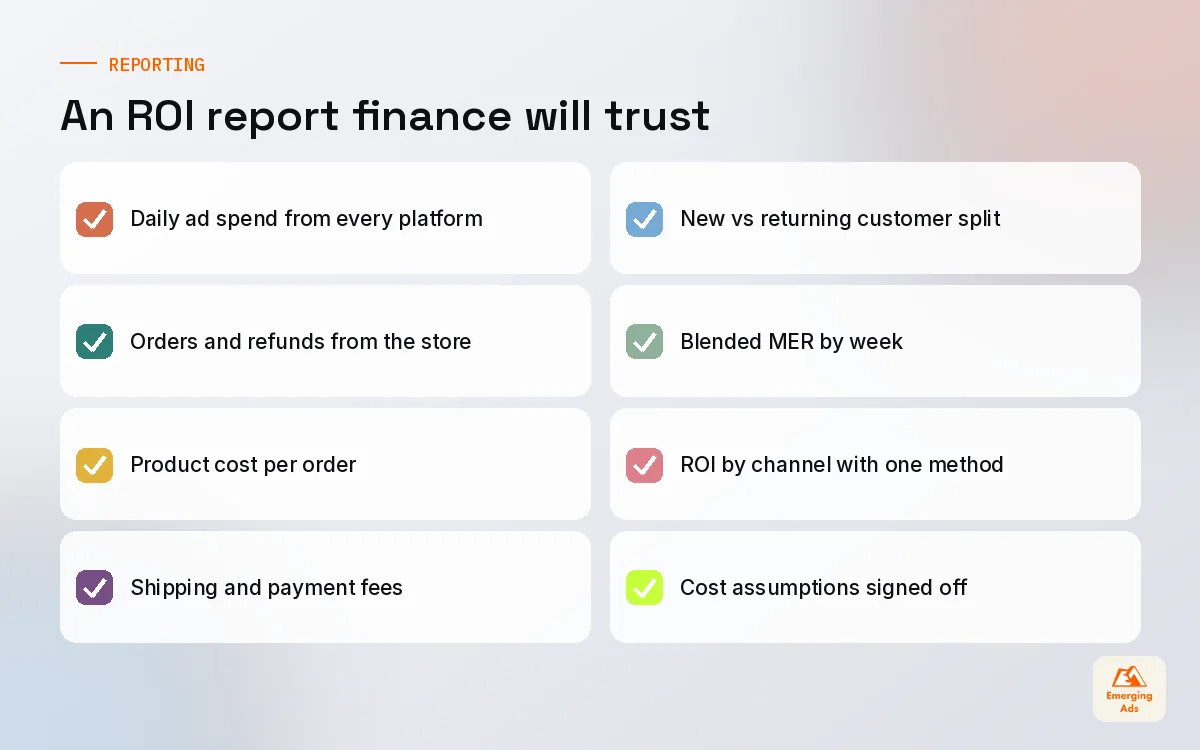
Most marketing reports stop at ROAS because the data needed for ROI sits outside the ad platforms. The fix is to bring cost data and revenue data into one place and agree on definitions once.
- Pull ad spend from each platform daily.
- Pull orders, revenue, refunds and discounts from your store or CRM.
- Add product cost and variable cost per order, even as an average percentage to start with.
- Calculate blended MER, ROAS and ROI by week, and ROI by channel using your chosen attribution method.
- Show new customer revenue separately from returning customer revenue.
We build this in a Looker Studio dashboard for most clients, with the finance team signing off the cost assumptions. Once finance trusts the report, budget conversations get shorter and far less emotional. Getting GA4 set up properly underneath it matters too, because a report is only as trustworthy as the events feeding it.
A report that marketing and finance both believe is worth more than any single optimisation.
08Where to start this week
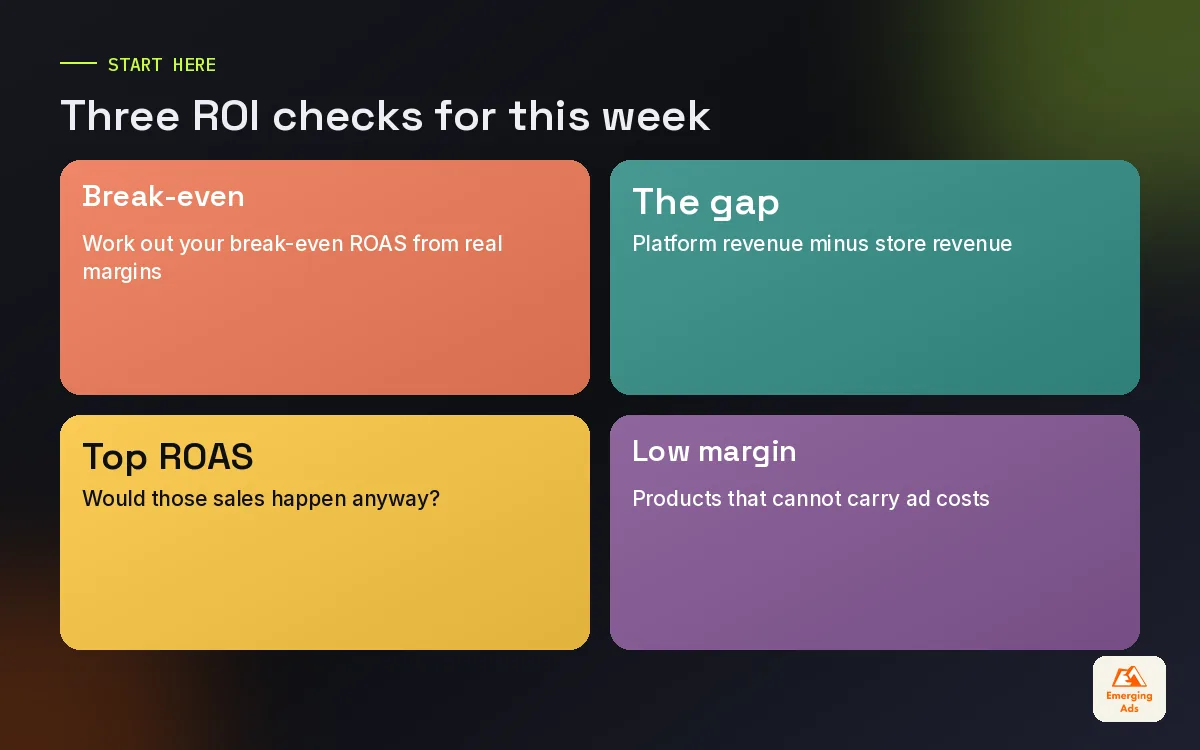
If you only do three things after reading this, make them these. First, calculate your break-even ROAS from real margins. Second, compare total platform-reported revenue with actual store revenue for last month and note the gap. Third, pick the one campaign with the highest reported ROAS and ask whether those sales would have happened without it.
Those three checks alone usually reshape a budget. If you want the wider picture of how channels and budgets fit together, read our media planning guide next. And if you want a specialist to look at your numbers, our team offers a Facebook ads audit as well as a full review across every paid channel. You can also browse the oldemergingads.com homepage for how we report profit before reach.
Frequently asked questions
Straight answers to what clients ask us most about ad spend roi.
What is ad spend ROI?
How do I calculate ROI on ad spend?
What is the difference between ROI and ROAS?
What is a good ROI for advertising?
What is break-even ROAS?
Why does my ad platform show a higher ROAS than my store?
Should I include agency fees in ad spend ROI?
How long should I wait before judging ROI?
Can ad spend ROI be negative and still be worth it?
What tools do I need to track ad spend ROI?
How can I improve ad spend ROI quickly?
Is your ad spend making money, or just making revenue?
Share your last 90 days of spend, revenue and margins. We will calculate your true ad spend ROI by channel and show you which campaigns are quietly losing money.
Book your free audit