Landing Page Optimisation: The Practical Guide We Hand to New Clients
We buy media for a living, and the most expensive thing we see in ad accounts is not a bad bid. It is a good ad sending people to a page that lets them down. This guide covers how we fix landing pages before we ask clients to spend more.
Key takeaways
- Landing page optimisation is about making the page keep the promise the ad made, quickly, on a phone, with one clear next step.
- Message match is the first fix. If the headline does not echo the ad, many visitors leave before reading anything else.
- Speed is a conversion factor, not a technical detail. Most paid traffic arrives on mobile, often on slower connections.
- Test big changes first: offer, headline, page structure and form length. Button colours come much later.
- Measure every page on the metric that matters to the business, such as qualified leads or purchases, not on time on page or bounce rate alone.
01What landing page optimisation really is
A landing page is any page where paid traffic arrives. It might be a purpose-built page with no navigation, a product page, or, all too often, a homepage that was never designed to convert anyone from an ad. Landing page optimisation is the ongoing work of making those pages turn more of the right visitors into customers or leads.
For a paid media team, it is also the cheapest way to lower acquisition costs. If a page converts at 2 percent and you lift it to 3 percent, every campaign pointing at it becomes a third cheaper per result without touching a single bid. That is why we treat the page as part of the ad, not as a separate project owned by someone else.
This is not the same as a full website redesign. It is focused, measurable work on the pages that receive paid traffic, done in the order that moves results most. If you want the broader principles of conversion work, our main site explains how conversion rate optimisation works. Here we stay close to the paid traffic side.
02Message match: the fix we make first
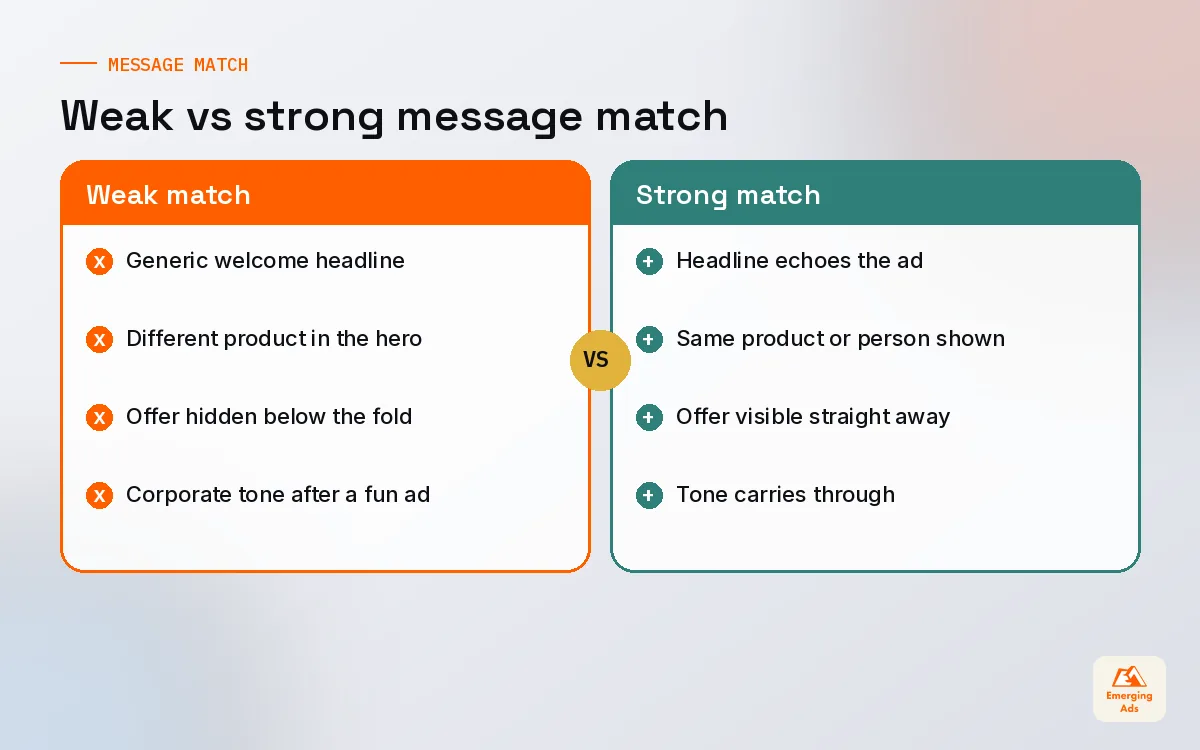
Message match means the page continues the exact conversation the ad started. Someone who clicked an ad about “same-day AC repair in Dubai Marina” should land on a headline about same-day AC repair in Dubai Marina, not a generic “Welcome to our company” banner.
We check four elements between ad and page:
- Headline: repeats or closely echoes the promise in the ad.
- Visual: the same product, person or scene the visitor just saw.
- Offer: the discount, free trial or guarantee from the ad, visible above the fold.
- Tone: a playful TikTok ad should not land on a stiff corporate page.
For accounts running many ad angles, this usually means more than one landing page. We often build a small set of variants, each matched to a group of ads. Tools like Unbounce and Instapage make this faster, though a well-built page on your own site works just as well. Our creative testing guide explains how ad angles are grouped, which then maps directly to page variants.
03The structure of a page that converts paid traffic
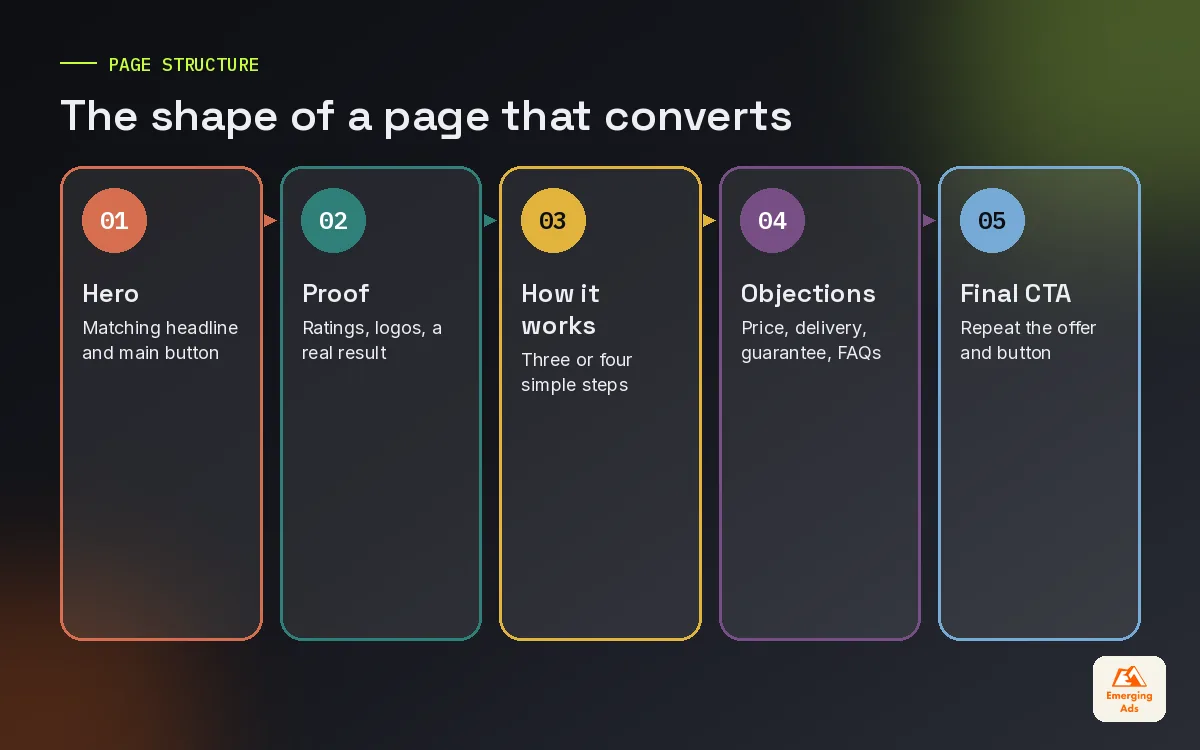
Every page is different, but high-converting paid landing pages tend to share a structure. This is the order we build in.
- Hero: headline that matches the ad, one line of support, a clear visual, and the main call to action visible without scrolling.
- Proof strip: ratings, logos, a short testimonial or a number you can back up.
- Problem and outcome: what the visitor is struggling with and what life looks like after.
- How it works: three or four simple steps that remove uncertainty.
- Detailed proof: reviews, case studies, before and after, credentials.
- Objection handling: price, delivery, guarantees, and an FAQ block.
- Final call to action: repeat the offer and button.
Remove anything that distracts from the one action you want. Full site navigation, links to your blog and social icons all give visitors ways to leave. On dedicated pages, we strip them out. Our landing page design service builds pages to this structure, adapted to each client’s brand.
04Speed and mobile: where paid traffic is lost
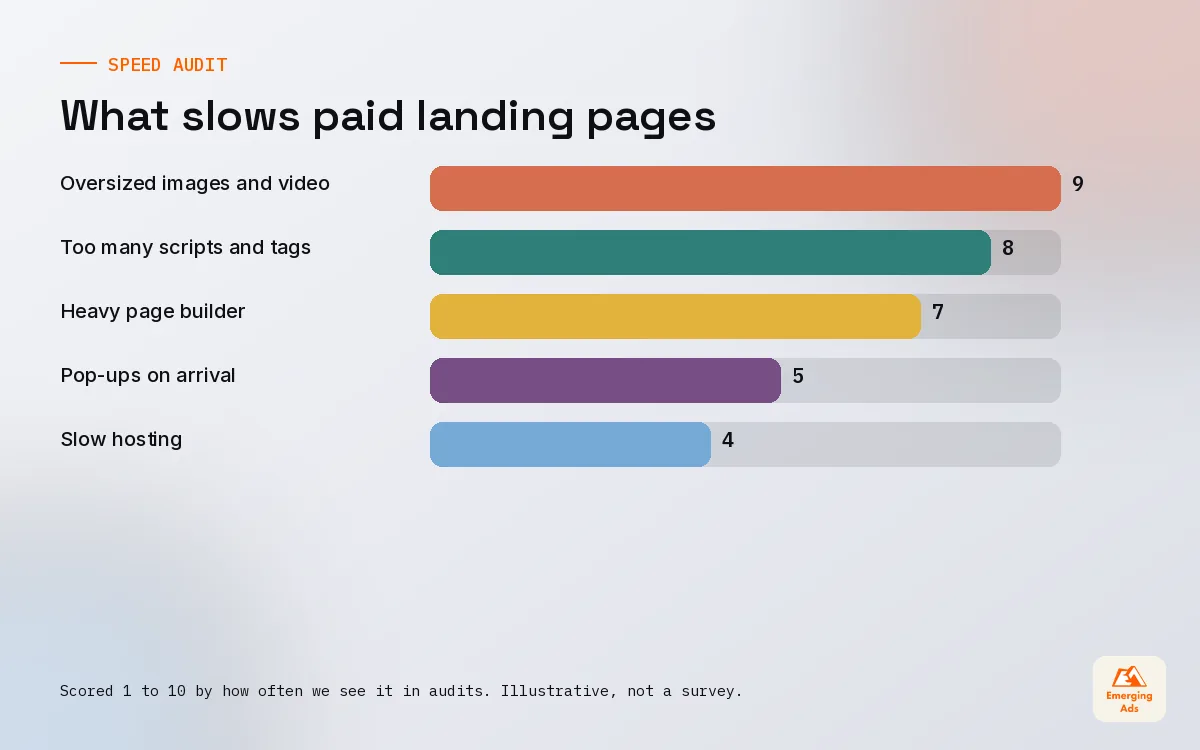
Most of the paid traffic we buy on Meta, TikTok and YouTube arrives on phones, frequently inside in-app browsers that are slower than a normal mobile browser. A page that feels fast on an office laptop can feel painfully slow there.
| Common cause | What we do about it |
|---|---|
| Huge hero images or videos | Compress, resize for mobile, use modern formats such as WebP, and lazy load anything below the fold |
| Too many scripts and tags | Audit tags, remove unused ones, and load non-essential scripts after the page renders |
| Heavy page builders and themes | Simplify the page or rebuild it on a lighter template |
| Pop-ups on arrival | Delay or remove them on paid landing pages |
| Slow hosting | Move to faster hosting or add a content delivery network |
For Shopify stores, speed work has its own quirks around apps and themes, which our Shopify speed optimisation team handles. Whatever the platform, we test on real phones on mobile data, not only in desktop tools.
05Forms, checkouts and calls to action
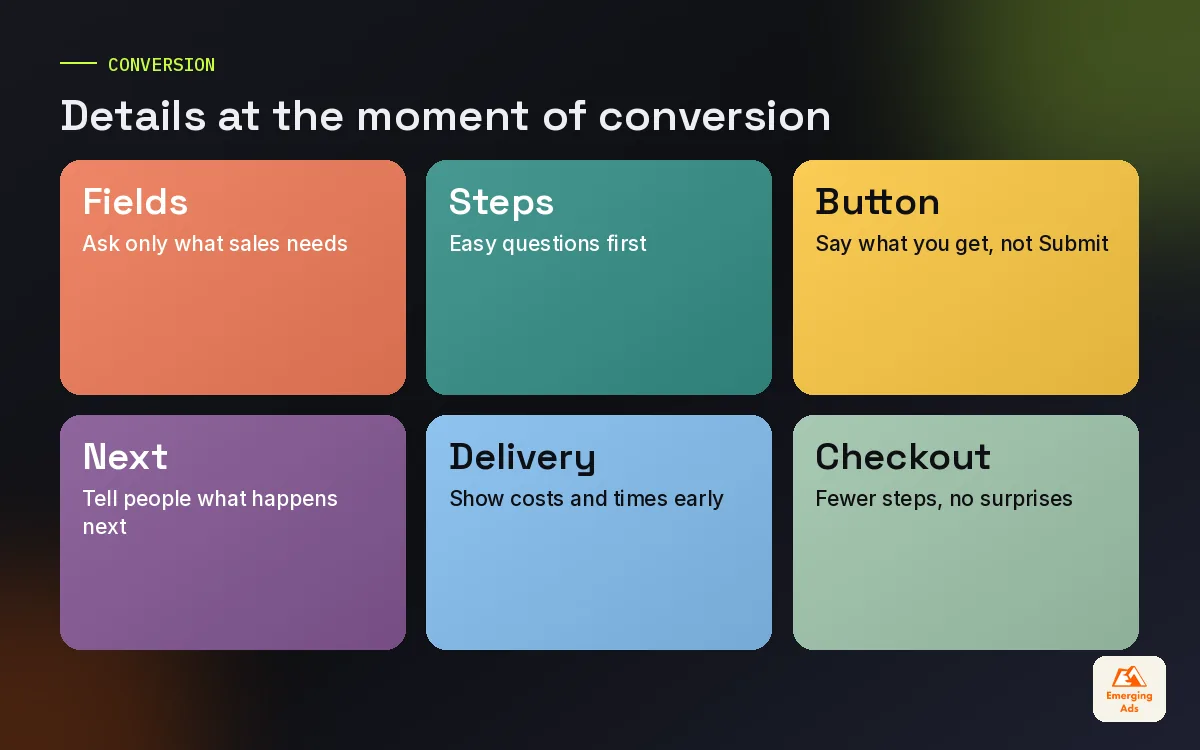
The moment of conversion is where small details add up. We see the same issues repeatedly.
Lead forms
Ask only what you need to qualify and follow up. Every extra field loses some people. That said, removing qualifying questions can flood sales with poor leads, so balance form length against lead quality. Multi-step forms, where easy questions come first, often feel shorter than they are.
Calls to action
Use specific button text such as “Get my quote” or “Book a free call” rather than “Submit”. Say what happens next: “We reply within two working hours” removes a lot of hesitation.
E-commerce product and checkout pages
Show delivery times and costs early, make the add to cart button unmissable, and keep checkout steps to a minimum. Surprise fees at checkout are one of the most common reasons shoppers give up. Our Shopify conversion optimisation work spends a lot of time here.
06How to find what is broken
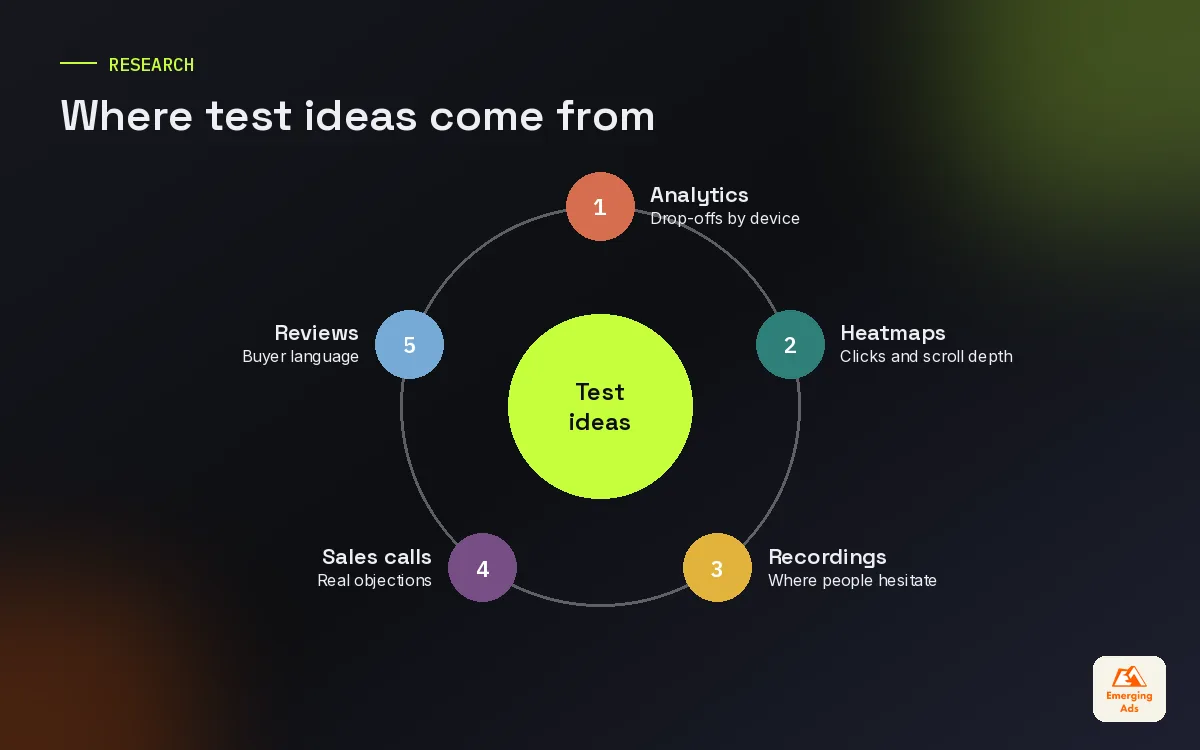
Before changing anything, we look at how visitors actually behave. Three sources give most of the answers.
- Analytics: conversion rate by device, traffic source and page, plus where people drop out of the funnel. A clean GA4 setup with the right events makes this possible.
- Heatmaps and recordings: where people click, how far they scroll, where they hesitate. Our heatmap analysis setups usually reveal something surprising within a week, such as visitors trying to click an image that is not a link.
- Customer voice: sales call notes, support questions, reviews and short on-page surveys. They tell you which objections the page fails to answer.
Combine the three and a pattern usually appears. Perhaps mobile visitors never scroll past the hero, or a pricing question keeps coming up that the page never answers. Those findings become your test ideas.
07Testing landing pages the right way
A/B testing is the gold standard, but it needs enough traffic and conversions to reach a trustworthy result. Many small accounts do not have that, and running a test for months to prove a tiny lift is not a good use of time.
| Traffic level | Approach we use |
|---|---|
| High (many conversions a week) | Formal A/B tests with one change at a time and a set duration |
| Medium | Test bigger changes, such as a new headline plus hero, and run for at least two full weeks |
| Low | Make evidence-based changes from research, then compare before and after carefully |
Test in the same order as ad creative: big levers first. The offer, headline, page structure and form length usually matter far more than colours or button shapes. Keep a test log with the hypothesis, the change and the result, so lessons carry across to other pages.
Landing page tests worth running first
- Offer framing: free trial against money-back guarantee, percentage discount against a gift with purchase.
- Headline angle: outcome-led against problem-led, using the same angles that won in your ad tests.
- Page length: a short page against a long page with more proof, especially for higher-priced offers.
- Form design: single step against multi-step, or fewer fields against more qualifying questions.
- Proof placement: reviews and results moved from the bottom of the page to directly under the hero.
Each of these changes something a visitor actually notices, which is why they tend to produce clear results even on accounts with modest traffic.
A landing page test that changes nothing a visitor would notice will not change anything a visitor would do.
08A pre-launch landing page checklist
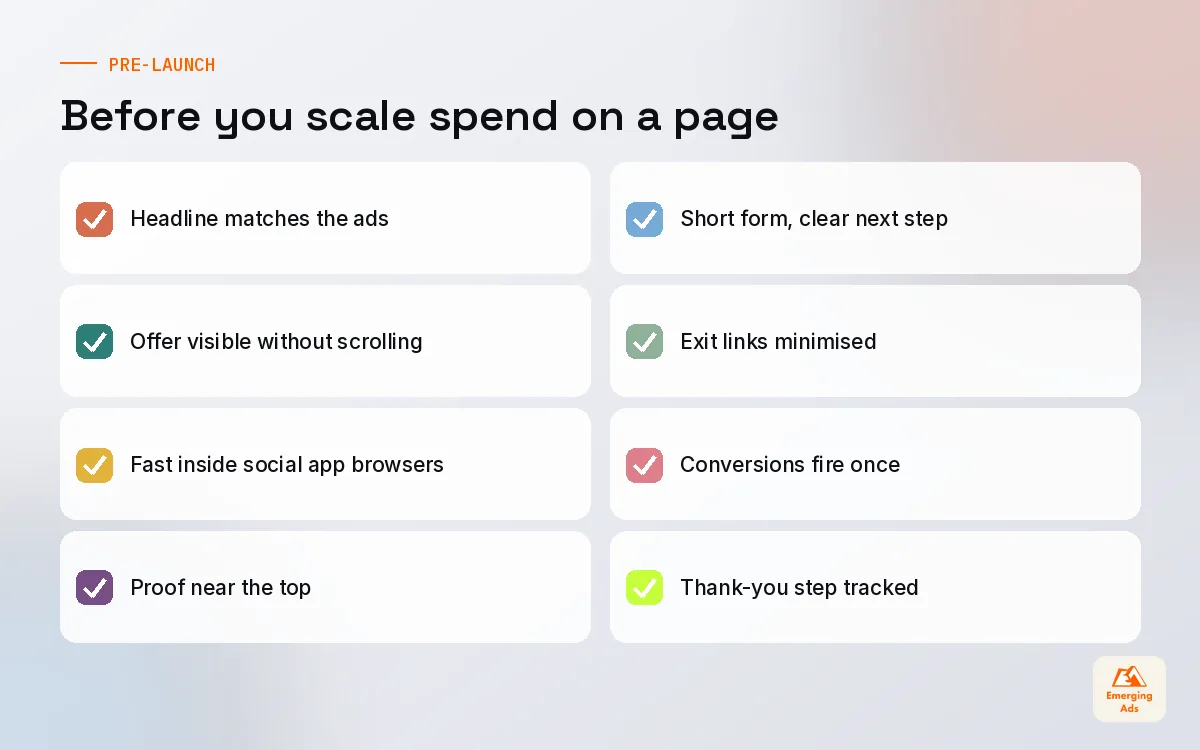
We run this checklist before scaling spend on any page. It takes about half an hour and catches most of the expensive problems.
- Headline matches the ads pointing to the page.
- Offer and call to action visible on a phone without scrolling.
- Page loads quickly on mobile data inside a social app browser.
- Proof appears near the top, not buried at the bottom.
- Form asks only what sales needs, and says what happens next.
- Navigation and exit links removed or minimised on dedicated pages.
- Conversion events fire once, with the right value, in analytics and ad platforms.
- Thank-you page or confirmation step works and is tracked.
The tracking item matters more than it looks. If conversions are not recorded properly, the ad platforms optimise towards the wrong people and you cannot tell whether a page change helped. A proper conversion tracking setup is part of every page launch we do. For ongoing work across a whole site, our website CRO services take this beyond single pages. See the ad spend ROI guide for how page improvements show up in profit, or visit the oldemergingads.com homepage for how landing pages fit into our paid media work.
Frequently asked questions
Straight answers to what clients ask us most about landing page optimisation.
What is landing page optimisation?
What is a good landing page conversion rate?
Should I send ad traffic to my homepage?
How many landing pages do I need?
How long should a landing page be?
What is message match on a landing page?
How does page speed affect conversions?
Which landing page builder should I use?
How many form fields should a lead form have?
Can I A/B test with low traffic?
How often should I update landing pages?
Paying for clicks that never convert?
Send us your top three landing pages and the ads that point to them. We will review message match, speed and structure, and give you a prioritised list of fixes.
Book your free audit