Media Planning: The Practical Guide We Hand to New Clients
A media plan should tell you where every rupee, dollar or dirham goes, why it goes there, and what you will do when the numbers come back. This is the version we build for new clients in their first two weeks.
Key takeaways
- Media planning is deciding where your ads run, who sees them, how often, and how much each channel gets, before a single campaign goes live.
- Start from the business number you need (orders, leads, revenue at a target margin) and work backwards to reach, clicks and spend. Never start from last year’s budget split.
- Our 6-step process runs from goal to review cadence, and a first version can be built in a week with clean data.
- Keep 70 to 80 percent of spend on proven channels and ring-fence the rest for tests, so the plan can learn without putting the month at risk.
- A plan is only as good as the measurement behind it. Fix tracking before you argue about channel splits.
01What media planning actually means in 2026
Ask ten marketers what media planning is and you will get ten answers. For some it is a spreadsheet of channels and budgets. For others it is the big annual deck with personas on page three. When we take on a new account, we use a narrower definition that is easier to act on: media planning is the set of decisions about where your ads appear, who they reach, how often, and how much money each placement gets, made before you spend.
Media buying is what happens next. The buyer sets up campaigns, manages bids, rotates creative and moves budget day to day. Planning sets the boundaries the buyer works inside. When the two are done by the same team, as they are in our paid media services, the plan changes faster because the people writing it are staring at the live numbers every morning.
The old split between planning (months ahead, big picture) and buying (daily, tactical) has shrunk. Platforms like Meta and Google now do much of the targeting for you, so the plan is less about picking audiences by hand and more about deciding which problems each channel is there to solve, and how you will know if it is solving them.
Media planning vs media buying
| Media planning | Media buying | |
|---|---|---|
| Question it answers | Where, who, how much and why | How, at what price, and what to change today |
| Time horizon | Quarter or month | Day and week |
| Main output | Channel mix, budget split, KPIs, test plan | Live campaigns, bids, creative rotation |
| Fails when | It ignores margin and measurement | It ignores the plan and chases cheap clicks |
02Why most media plans fail before launch
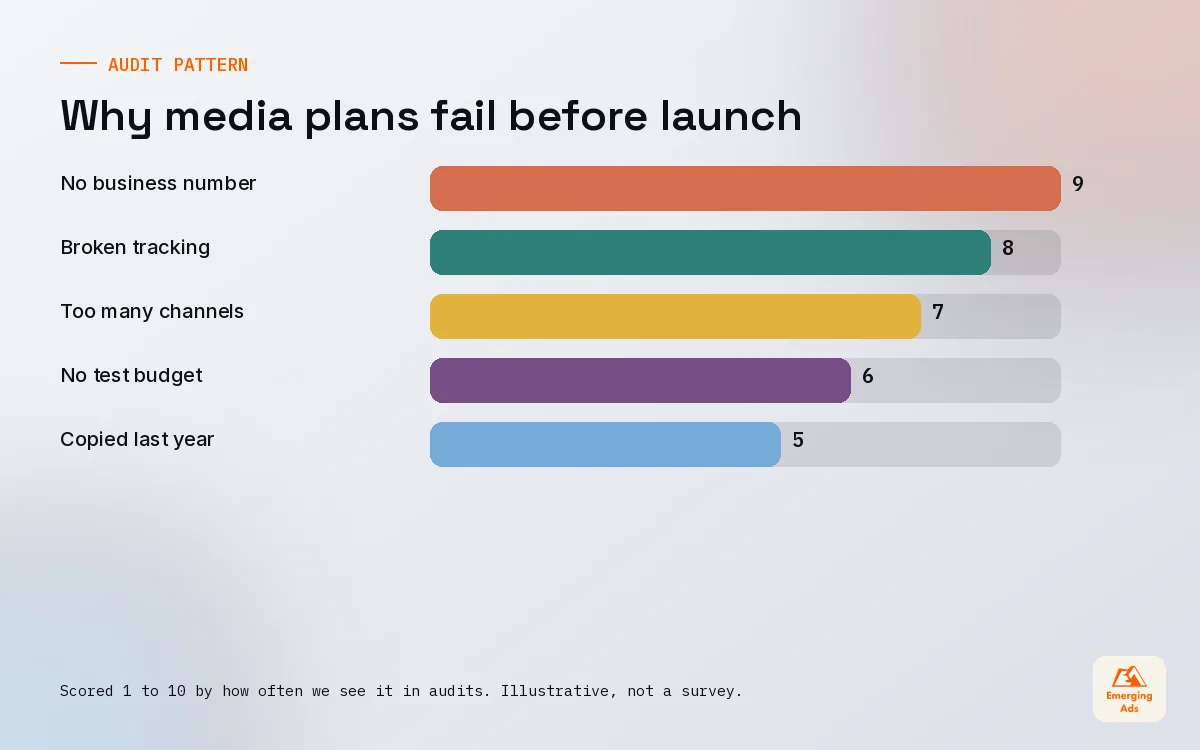
We audit a lot of plans written by other agencies and in-house teams. The ones that fail tend to fail for the same handful of reasons, and almost none of them are about picking the wrong channel.
- No business number at the top. The plan says “grow awareness” or “drive traffic” instead of “300 orders a week at a cost per order under 900”. Without a number, you cannot tell if the plan is working.
- Budget split copied from last year. Channels change, costs change, the product changes. Last year’s split is a starting point for discussion, not a plan.
- Every channel at once. Spreading a modest budget across six platforms means none of them gets enough data to optimise. Two or three channels done properly usually beat six done thinly.
- No room to test. If 100 percent of the budget is locked into existing campaigns, the plan cannot learn anything new.
- Broken tracking. If the pixel double counts or the CRM never sends offline conversions back, the plan will reward the wrong channel.
03The 6-step media planning process we use
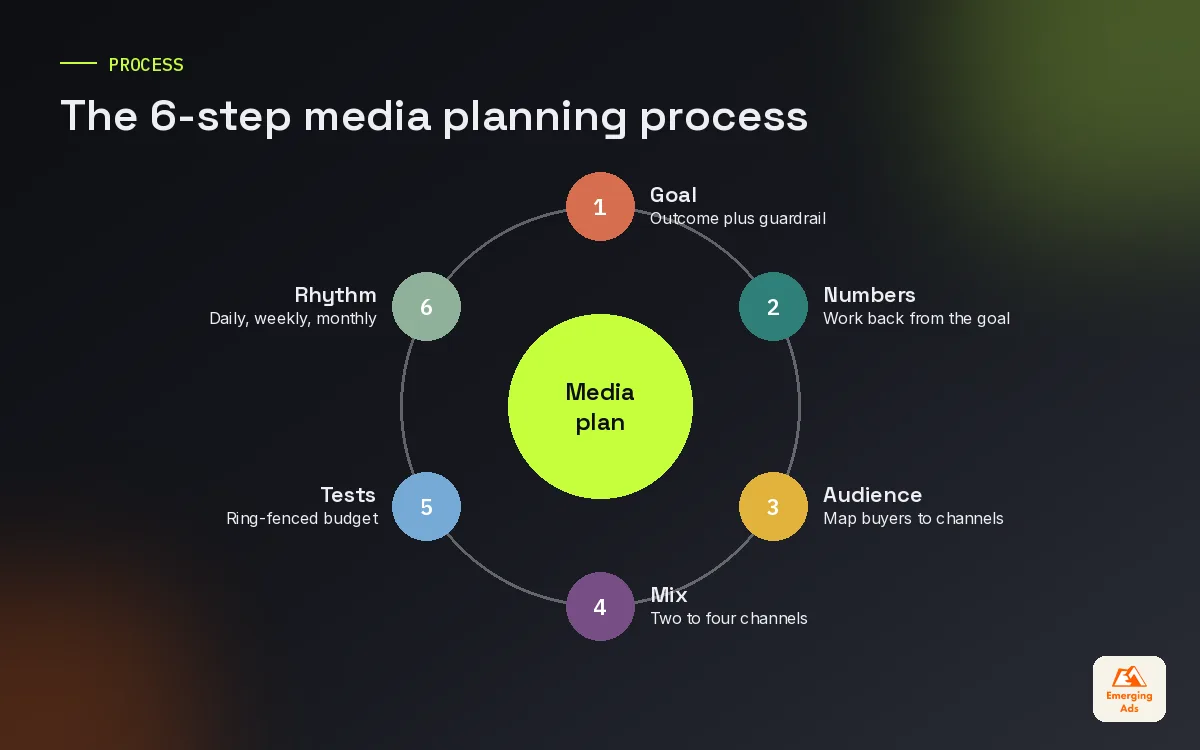
This is the process we follow in the first two weeks with a new client. Each step produces a short written answer, and the whole plan fits on one spreadsheet tab plus a one-page summary.
1. Set the business goal and the guardrail
Write down the outcome and the limit. For an online store that might be “grow monthly revenue from paid media to X while keeping blended cost of acquisition under Y”. For a lead-generation business it is usually qualified leads per month and a maximum cost per qualified lead. The guardrail matters as much as the goal, because it tells the buyer when to stop spending.
2. Work backwards to the numbers you need
Turn the goal into a funnel. If you need 300 orders and your site converts at 2 percent from paid traffic, you need roughly 15,000 paid sessions. If your average cost per click is around 0.40, that is about 6,000 in spend before you account for anything else. The numbers in this example are illustrative, but the maths is the whole point: it shows quickly whether the goal is realistic with the budget on the table.
3. Map the audience to channels
List where your buyers already spend attention and what state of mind they are in there. Search captures people who already know what they want. Social and short video create demand among people who did not know they wanted it yet. Marketplaces catch buyers at the very last step. The channel map should reflect that mix, not just the platforms your team happens to like.
4. Choose the mix and split the budget
Pick two to four channels and give each a clear job, a budget, and a target. We cover the maths of splitting spend in our companion post on ad budget allocation, but the short version is: fund the channel closest to the sale first, then add channels that feed it.
5. Plan the tests
Set aside a test budget, usually 10 to 20 percent, and write down the three or four questions you want answered this quarter. Will TikTok ads bring buyers at an acceptable cost for this product? Does a new landing page lift conversion? Each test needs a budget, a duration and a pass mark agreed in advance.
6. Agree the review rhythm
Decide who looks at what, and how often. We review spend and cost per result daily, channel mix weekly, and the plan itself monthly. Anything faster than that and you start reacting to noise.
04Choosing the channel mix
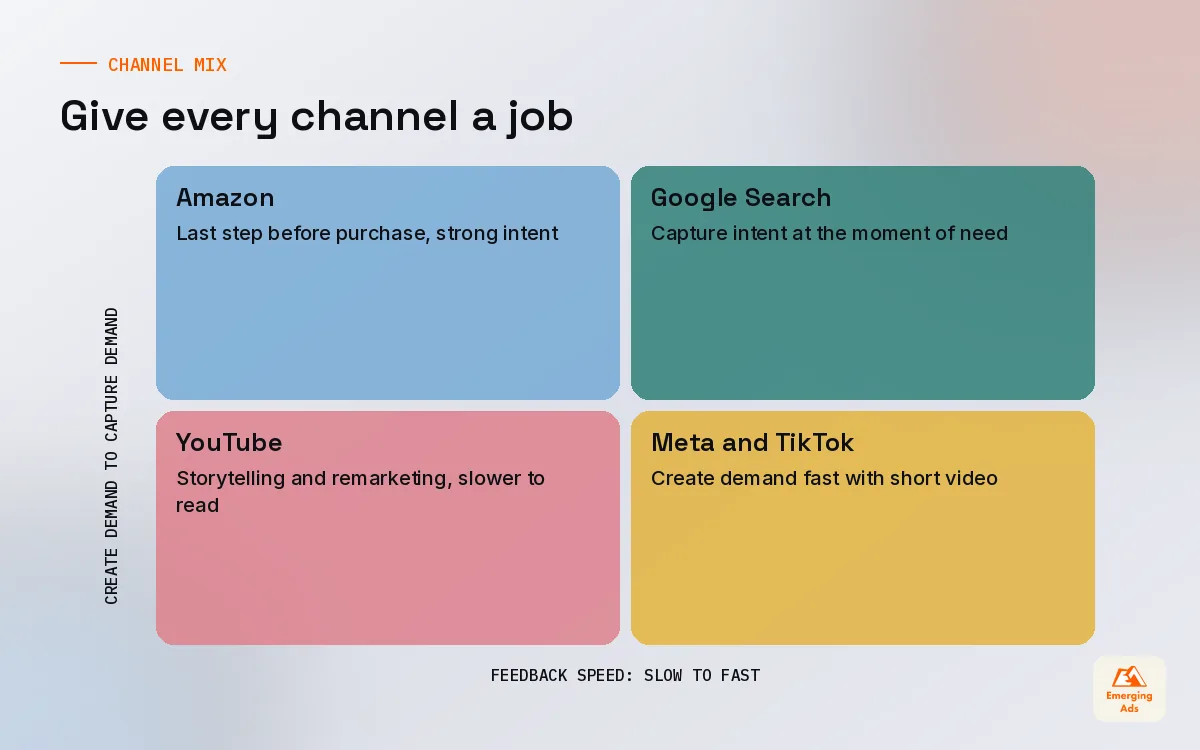
There is no universal best mix. What works for a skincare brand selling a 40 product online is different from what works for a B2B software firm with a six-week sales cycle. That said, the jobs each channel does well are fairly consistent across the accounts we run.
| Channel | Best job in the plan | Watch out for |
|---|---|---|
| Google Search | Capturing existing demand at the moment of intent | Paying for your own brand name when you would have got the sale anyway |
| Meta (Facebook and Instagram) | Creating demand and scaling proven offers with broad targeting | Creative fatigue, which shows up as rising costs within weeks |
| TikTok and Snapchat | Reaching younger buyers cheaply with native, fast video | Treating it like Meta and running polished brand ads that get skipped |
| YouTube | Longer storytelling, remarketing and search-like intent on video | Measuring it only on last-click conversions |
| Amazon Ads | Winning the shelf when buyers are ready to purchase | Chasing sales at a cost that wipes out the margin |
For most clients we start with search and one social platform, because that pairing covers both capturing demand and creating it. We add YouTube advertising when there is enough video creative to support it, and Amazon advertising when a meaningful share of sales already happens on the marketplace.
Emerging platforms deserve a place in the test budget rather than the core plan. We have seen Snapchat campaigns outperform Meta for specific audiences in the Gulf, for example, but we only move them into the core once they have proven it over several weeks.
05How to split the budget without guessing
The most common question we get about media planning is how much to put where. Our honest answer is that the first split is always a hypothesis. What matters is having a sensible starting point and a rule for moving money once data arrives.
A simple rule we use for new plans:
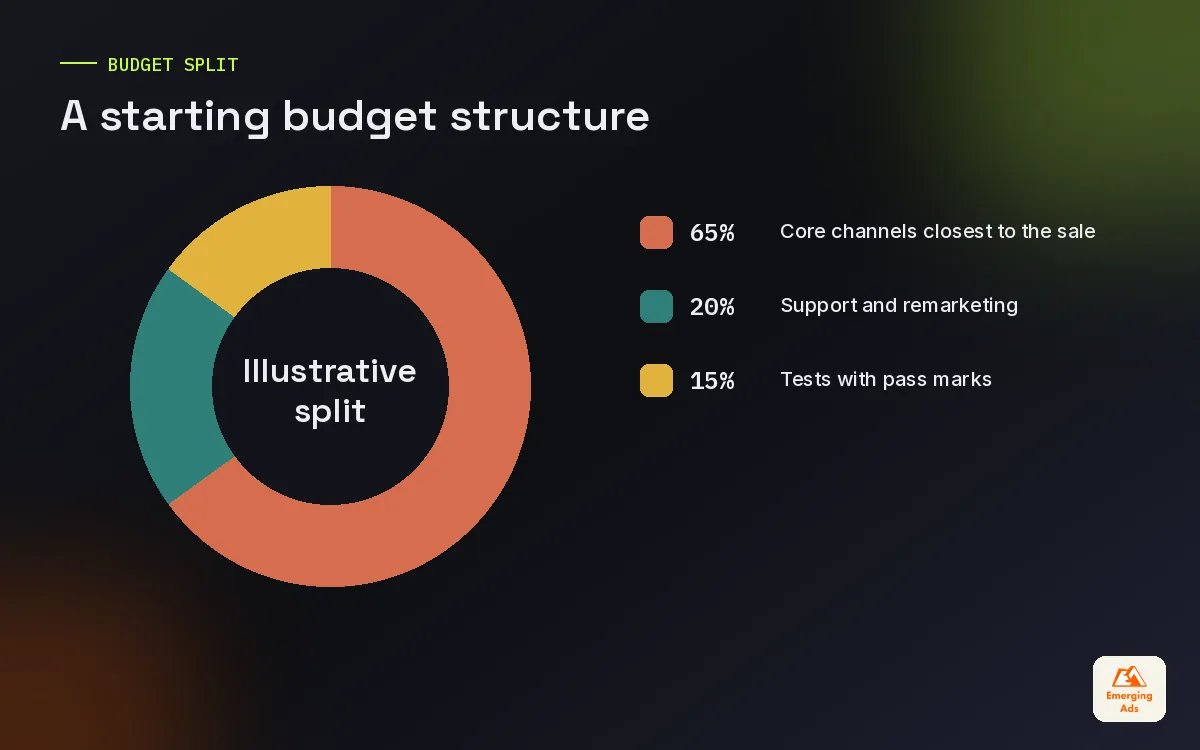
- Core (60 to 70 percent): the channel or two with the clearest, most measurable path to the sale. For many brands that is Google Ads search plus Meta prospecting.
- Support (15 to 20 percent): remarketing and channels that feed the core, such as video views that later get retargeted.
- Test (10 to 20 percent): new platforms, new audiences or new offers, each with a pre-agreed pass mark.
Once a month, move budget toward whatever is beating its target and away from whatever is missing it for a second month running. One bad month is noise. Two is a pattern.
06A media plan template you can copy
Our plans live in one spreadsheet tab with one row per campaign line. The columns below are the ones that actually get used. Anything more and the plan stops being read.
| Column | What goes in it |
|---|---|
| Channel and campaign | Platform, campaign name and objective |
| Job | Capture demand, create demand, remarket, or test |
| Audience | Broad, lookalike, interest, keyword theme or remarketing pool |
| Monthly budget | Planned spend, plus the share of total |
| Primary KPI | Cost per purchase, cost per lead, ROAS or cost per view |
| Target and floor | The number you want and the number that triggers a cut |
| Creative needed | Formats, sizes and how many new pieces per month |
| Landing page | The exact URL each line sends traffic to |
| Owner and review | Who manages it and how often it gets reviewed |
The landing page column is the one most templates leave out, and it is often where plans leak. If three campaigns with different promises all point to the homepage, conversion rates suffer. Matching each line to a page built for it is exactly why we pair plans with landing page design work where needed.
07Measuring whether the plan is working
Every platform will tell you it is doing a great job. Meta counts conversions it influenced, Google counts conversions it influenced, and the total is often more than the sales you actually made. A media plan needs one version of the truth that sits above the platforms.
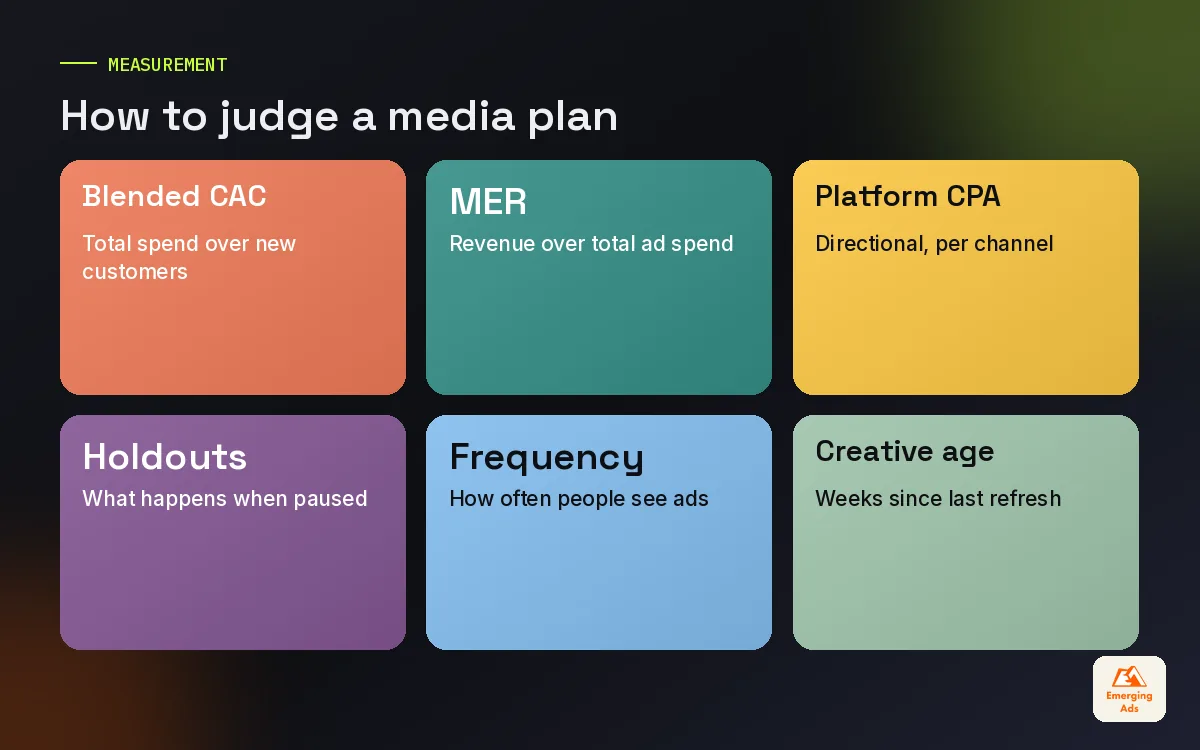
- Blended numbers first: total paid spend divided by total new customers or leads, measured from your store or CRM, not from the ad platforms.
- Platform numbers second: useful for optimising inside each channel, but read them as directional.
- Incrementality where you can: holdout tests or geo tests to see what happens when a channel is paused.
We usually build a simple Looker Studio dashboard that shows blended results next to platform-reported results, so the gap is visible every week. When the gap gets large, it is time to look harder at attribution modelling rather than trusting any single platform’s view.
If the platforms claim more sales than your bank account received, believe the bank account.
08Media planning mistakes we fix in the first month
These come up so often in new accounts that we now check for them on day one.
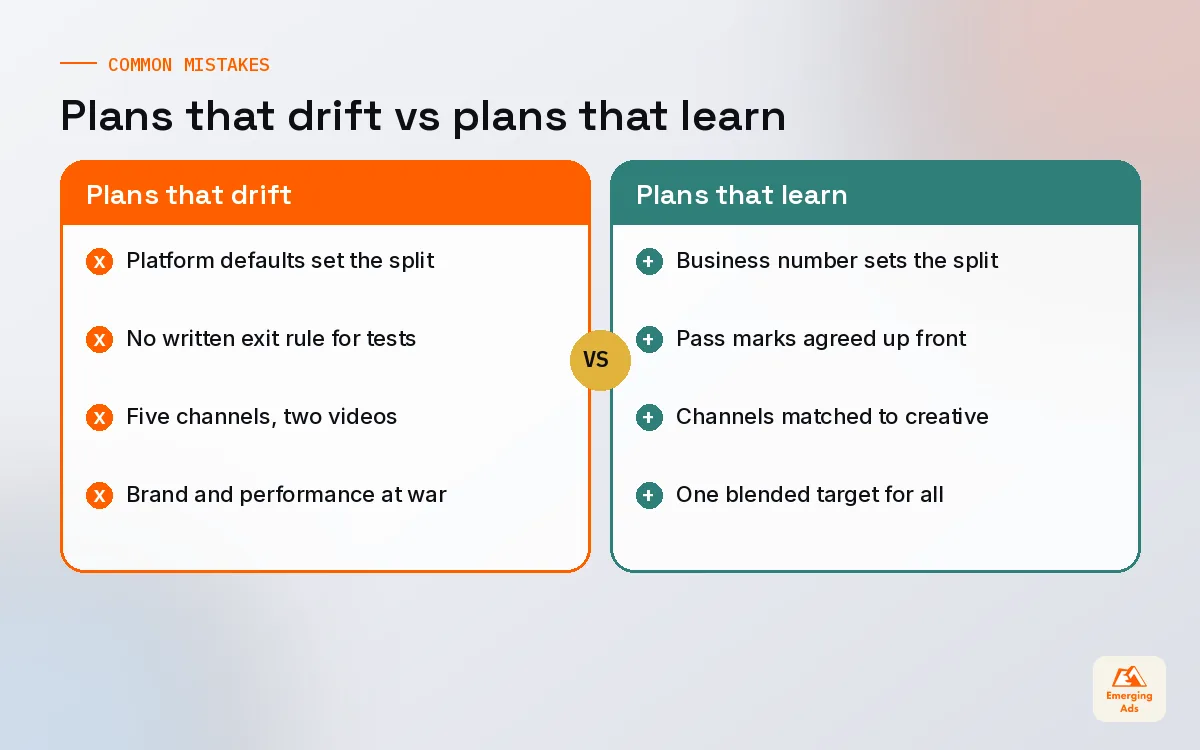
- Planning by platform default. Letting each platform’s recommended budget decide the split. Platforms recommend spending more on themselves.
- Ignoring frequency. Small audiences shown the same ad fifteen times a week get annoyed, not persuaded.
- No creative plan. The media plan asks for five channels but the design team can make two videos a month. Creative supply limits what a plan can do.
- Treating brand and performance as separate budgets with separate goals. They affect each other. Cutting all upper-funnel spend often shows up as rising search costs a month or two later.
- No written exit rule. Tests drift on for months because nobody agreed what failure looked like.
None of these need a bigger budget to fix. They need a plan that is written down, reviewed on a schedule, and owned by someone who can say no. If you want to see how we run that in practice, the oldemergingads.com homepage has an overview of how we approach media buying and profit reporting.
Frequently asked questions
Straight answers to what clients ask us most about media planning.
What is media planning in digital marketing?
What is the difference between a media plan and a marketing plan?
How long does it take to create a media plan?
How much budget do I need for media planning to matter?
Which channels should be in my media plan?
How often should a media plan be updated?
What KPIs belong in a media plan?
Should I include a test budget in my media plan?
What is a media plan template?
Can I do media planning in-house?
How do I know if my media plan is working?
Want a second pair of eyes on your media plan?
Send us your current channel split and last 90 days of results. We will show you where the plan and the numbers disagree, and what we would move first.
Book your free audit